


☝️ Hey, Reader. Did you know you can be a listener or a follow-alonger? That’s me reading the following essay as I hear it in this skull. Care to join me?
Conversations of worth

Recently, I’ve had two conversations with other men that have me thinking about how men measure our worth, and how it’s inextricably tied to our success. These conversations have made me wonder about the wisdom of measuring self-worth by just one aspect of our lives, whatever that aspect may be.
TL;DR - Our worth as men is greater than our success at any point in our lives.
One conversation in particular solidified my decision to write this essay. A good friend of mine is trudging through familiar mud, struggling to be successful in his chosen career. It’s undermining him at every turn, in ways I won’t share here, lest I betray his confidence. Suffice it to say that teary-eyed dialogue cinched it for me.
We have to talk about this, which means I have to write about it.
Last week in the men’s group I host, one of the guys asked me how I was doing. This question is either the easiest or hardest question in the world. Nobody will convince me otherwise.
I decided to take the hard path.
“You know,” I replied, “I’m generally good, but I’ve been coming to terms with the fact that I’ve been experiencing something like depression for a little more than a year.”
The first two guys on the call were a little shocked by my frankness. One said something to the effect of, “That doesn’t sound good.”
He was right. It sounded concerning.
What made matters worse is that everything I said afterward seemed like I was covering something up. As the other guys showed up to the call, I caught them up. Explaining myself, something I recently advised against in another Substack essay, had even me wondering if I wasn’t, in fact, covering something up.
I wasn’t, but like being accused of culpability, almost anything one says sounds like the song of a guilty person. I lobbied anyway.
“Guys, I’m fine, really. What I’m sure is true is that my three-decade-long practice of daily exercise and my twelve years of meditation are what’s managing the experience.”
In other words, I’m not depressed in any traditional way. I assured them I’m not stuck on the couch, and I’m not suicidal. I’d simply noticed there is a darkness. In fact, a proper therapist might argue my claim. If I’m not feeling hopelessly numb, is it really depression?
I don’t know. In some ways, I’m grateful to be ignorant of the facts because I don’t need to know.
The conversation dovetailed into an episode of Dissecting Damon™, which was all coming from a very real and loving place. These guys care about me. They won’t let me slide with “Hey, I’m fine, I’m fine.”
But I am fine. I’m just not feeling the full scope of my worth. I’m not feeling particularly successful financially.
This all raises a larger question: Is success really the best metric for a man’s worth?
Is success the best metric for a man’s worth?

To imagine a man’s worth is only measurable by success is like a woman measuring her worth by her attractiveness. Both remind me of poor investment strategies. In investments, one must diversify to weather all storms. So say the experts. Surely this could apply to self-worth.
Scott Galloway, educator and podcaster, a man who’s savvy about economics and opinionated about men, alludes to success in his definition of masculinity. For him, men are providers, procreators, and protectors.
Yeah, maybe. I tell (lie to) myself that I’m more partial to what Charles Dickens says about self-worth.
“No one is useless in this world who lightens the burdens of another.”
~Charles Dickens
At the risk of sounding crass, that knocks procreation right off the list. (Sorry, Scott) Making babies isn’t lightening anyone’s load, quite literally for the mother.
One could articulate Dickens more succinctly as…
One’s worth is more about what we are to others, measured by our humanity, not our financial success.
Even if Dickens was only thinking of dudes when he wrote that—prolly—I take him to mean each human’s worth. We men, however, reduce all that lightning of burdens into money. This is a man’s true measure of worth. It’s not success at sports, woodworking, or poker, not unless those endeavors lead to money.
Our portfolio, formal or otherwise, is a man’s mirror-mirror on the wall.
Men in places like Canada and the USA might speak of other virtues when pressed about their self-worth, like how being a good spouse or dad does the trick. Maybe, but when push comes to shove, success is underpinning this enlightened perspective. It’s easier to take the virtuous high ground when the story we’re telling ourselves about our success sounds like describing granite.
This is problematic, especially if that story cracks.
To frame this up, it’s worth mentioning that I’m an American living in Mexico. Here, the national average for monthly salary in 2025 is $1,500, and that’s the average. Some are living on much less. For most of the American and Canadian men hanging their self-worth on other virtues, I imagine they’d feel a lot differently if circumstances changed. I’m thinking of a hypothetical, like if they were physically broken and destitute from something like an accident.
It’s easy to define one’s self-worth by being a good dad or a good spouse when one is not sweating the next meal or paying the mortgage. Imagine trying to feel that way on $1,500 a month.
Ironically, the men of Mexico are more likely to derive their feeling of self-worth from being part of a loving family. Never mind how wealthy they are. I don’t know if this makes them better people. That’s not my point. It’s just an interesting comment on self-worth.
Lest I sound like the typical, bitter expat, slinging arrows back at his countrymen, let’s go back to where we started: me, my self-worth, and my own messiness.
Men are mostly alone in this

What I’m feeling is 100% related to the story I tell myself about success. The story starts to sound like some shitty ballad when I let it out. It goes like this.
I used to make a lot more money. It’s been a minute since that was the case.
The last two years have been tough building a coaching practice. Making matters worse, I started this new venture on the heels of a decade of trying to succeed as a copywriter.
In the long run, marketing wasn’t a good fit for me. But the coaching biz? It’s just hard. That’s even true for coaches who come into coaching straight from a pre-existing and vibrant professional network.
My professional network was not that. Adding to that, I live abroad.
These are my excuses. They’re the refrain I sing to myself about where I stand, teetering on the canyon’s edge of depression, holding success in one hand, and self-worth in the other.
The verses of the ballad tell a story about the world not being set up for me, but none of it’s true, not really.
The bridge argues that what’s actually true is I simply haven’t cracked the code yet. Or I have, but I haven’t seen it mature. Businesses take time to build. So said everyone who tried to build one, including the larger majority, most of whom failed.
It’s gotta be a ballad. The blues and country always end with the rising sun.
Here’s the thing. I’m not alone, certainly amongst coaches, but also amongst men (and women too). The data backs me up.
The data on this is not clear, but telling
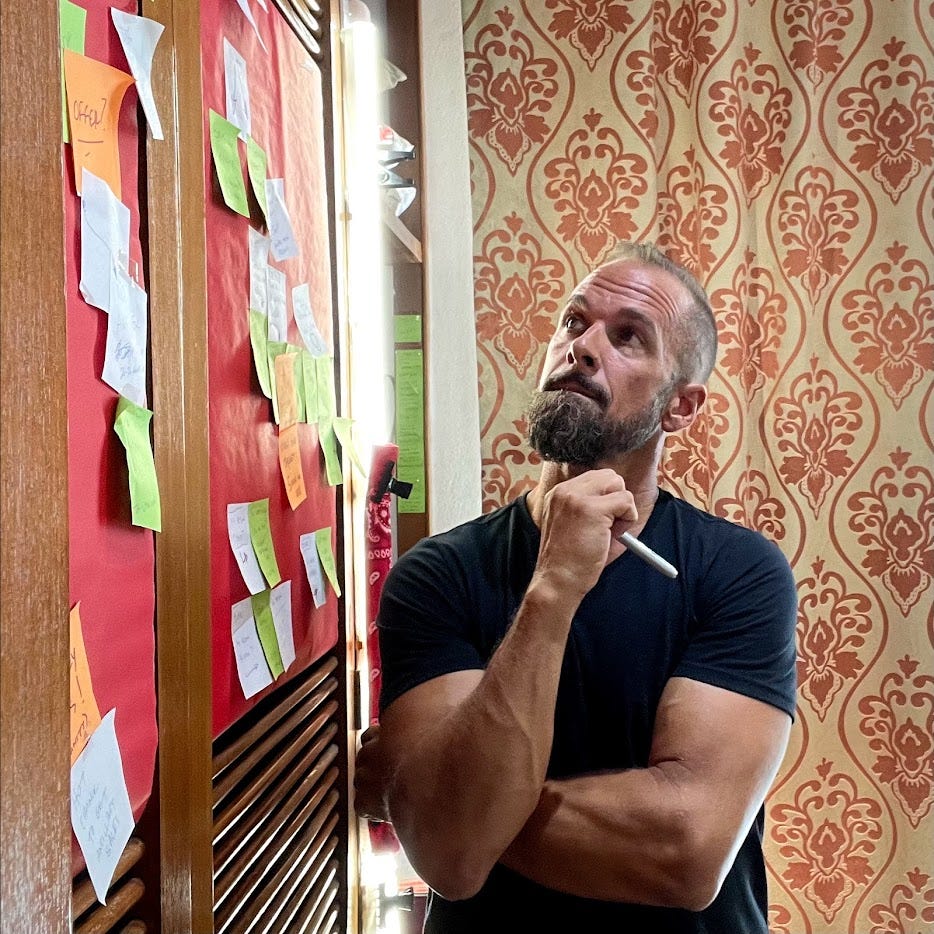
In 2024, PubMed research spanning data from 1970 to 2020, found that any one of us can suffer in the absence of a j-o-b.
The analysis reveals a significant positive association between unemployment and mental disorders, particularly anxiety, depression, and bipolar disorder. Moreover, distinct patterns emerge, linking unemployment to higher rates of drug use and eating disorders in specific demographics.
It appears women also relate to the self-worth connected to their success paradigm, but this isn’t exactly the finding. This data is more about how unemployment increases the potential for other negative patterns. It doesn’t directly claim why this happens.
In any case, I still view this as a human experience, especially in a Western world. In the West, we’re very attached to our vehicles and homes, but we introduce ourselves by our careers.
Hi, I’m Damon. I’m a coach for men. I may actually be a leadership coach for men, but I’m still ironing that out. (Insert: hearty laugh)
From this little bit, people can assume much about my heart, my mind, and my politics. And since I’m a man, they may also feel they know my worth, especially if they can smell anything about my status from the way I present myself.
Women, it seems, enjoy just as much, if not more confidence (a reflection of self-worth) from their careers as men do. The research on this is old; it’s apparently a closed case.
From a 1997 PubMed abstract:
Self-esteem was higher among women in highly autonomous jobs, and nonmarried women had higher self-esteem than others. The strongest effect on self-esteem was that of feeling competent as a worker.
The other compelling research I found was nearly as old as I, and it basically made the same points. Like I said, it’s a closed matter. We’ve known for a while that women also take value from their work. (Duh!)
The distinction for men is that we struggle to imagine another path to our self-worth. The obvious example is that we can’t get pregnant, not yet anyway.
We’re also confused about discovering worth through other means. That’s most of us, at least, or many of us. I can’t tell. As with any rule, there’s an exception that proves it (or so they say).
A man is reading this (thank you, sir) who believes I’m writing so much bullshit. Turning to Reddit as I plunked out this essay, I found a number of these men commenting that they do not attach their worth to the typical indicator of success, their careers.
A few mentioned what should be obvious validations of worth, like:
Being a dad (actively involved with the kids)
Volunteering
Mentoring
Confession: As I read these men’s accounts of their experience, part of me raised an eyebrow. Contrarians love Reddit. So do trolls.
Apparently, some men could lose their jobs, be out of work for prolonged periods of time, slowly draining resources, and they would not start to wonder if they’re worth anything.
I’m sure this is true. They’re dads, right? Again, maybe.
This all brings me back to Dickens, and to where I’m trying to invest in my own self-worth portfolio.
Are we really valuable by other means?

As a coach, I strongly value seeing others as they wish to feel seen. So, I see you, you ardent defender of other sources of self-worth. If you’re really out there, I believe we need your voice.
We need more voices like Charles Dickens lobbying for the simple and powerful value of lightening the burdens of another.
This philosophy of Dickens could also apply to those of us who prefer to define our sense of self-worth through success. I see you too. Your way is fine in my book, with one tiny invitation: that you put that powerful resource to use for the greater good. It’s nothing to do with virtue or stature, but about the stories we tell ourselves.
In truth, I hope to soon (and again) count myself amongst the men who feel successful. Far greater than the reward of living a luxurious life—something I already do if you ask our gardener, house cleaner, or pool cleaner—the ability to lighten the burdens of another with money I earned would be so rewarding.
I can’t deny that this piece added to my portfolio of self-worth would increase its valuation beyond measure. Until then, these are the categories where I’m investing.
Spouse. My commitment to my wife and being the best spouse I can be, supporting and loving her to the best of my ability, takes precedence.
As partners, we’ve taken on a challenging life by living abroad. It requires ongoing dialogue about what is and isn’t working. We speak almost daily on such matters. On Sundays, we share a moment stolen from Tim Ferriss (author, podcaster), where we each share:
What makes me feel gratitude toward you
What makes me feel gratitude toward myself (much harder)
What I want us to have more of
Wellness. My lifestyle is critical. I keep a daily wellness practice of movement and meditation.
As I mentioned in the story above, without these, I would be on medication and potentially facing depression. Firmly in place, these allow me to be the best me for my clients, family, and friends.
Leader. I will continue to pull men together in groups so that men can learn to be more tolerant of other men, themselves, and their discomforts.
These are my most powerful investments for now. When I’m operating from wisdom, these are the ways I define my sense of self-worth, even as I suspect there is more that is possible. This is good enough, and it is far from useless.
Thanks for reading.
~Damon
So what about you? How are you investing in your own self-worth these days?
This was the first of three essays on self-worth. Read the follow-up essay next.
I have so many thoughts on this. This is a huge subject for me — one that I have grappled with for years. I do not have great financial success in my career, and I have even been on the receiving end of confusion from other men about my position in life. "I don't understand why you aren't working somewhere else and changing the world," One man told me.
I've made innumerable attempts to change careers, and most haven't gone well. I'm also very limited in what I can do, given my daily struggles with Bipolar disorder. So I'm constantly struggling to navigate the limits and boundaries life has given me. It often hurts, and I'm just as sensitive to status as any other man.
I think I've found worth in principles of compassion, service, discipline, and integrity. These internal principles keep me afloat. But they are definitely in a constant tug-of-war with external forms of status.
It is notable to me that, in one study of suicide notes left by men, the most common word used was "useless." Feeling useless is one of the single deadliest experiences for men. I don't think it's wrong for men to want to feel useful and successful. I think we need to examine what that means, as you do here.
I could respond to so much in this extraordinary article, but I'll just answer the question at the end.
I'm at a cross-roads in my own sense of self-worth. I think I was programmed with a well-meaning template early in life that a life worth living means being valuable, and being valuable as a man means being A) a husband, B) a father, C) a good employee, and D) other electives like volunteering, being engaged with communities, etc.
The valley I find myself in right now is that none of those sources of value make sense to me. I'm not a husband anymore, and I don't even know if I want to be a partner. I'm not a father, and I don't know if I ever will be. I'm not an employee, and I don't see that changing anytime soon.
Instead, more sources of meaning come from the D category. Engaging in communities. Coaching individuals, participating in groups. Traveling the world, seeing sights unseen.
The void is yawning right now. You feel that more acutely when you're out of your born national context (see me: an "expat?" from the US living in Germany). I feel comfortable and unafraid. And also, deeply sad in ways too profound for words. I write poems about it, and that helps put some shape to the grief.
As a side note for the non-dual facet of the conversation (who is the self that needs to be valuable?) - I'm becoming more convinced that the lack of self-worth can lead one to adopt the mystical frame of no-self absent a genuine, direct experience of selflessness. In fact, if one has failed to measure up to the cultural measures of what makes you valuable in society, this could be an appealing escape hatch. I see that more and more these days.
Love you, brother. Thanks for the space to inquire into this topic.