


Hockey was not my sport, but there I was, at a professional hockey game in St. Louis. The girl I was with was someone I’d known since… gestation, basically. Our mothers both got pregnant around the same time.
The girl—let’s call her Tammy—was someone I’d taken to my senior prom in Minnesota just to make a splash. She reciprocated by taking me to hers, which was in Missouri. We were mostly friends, but through college, we’d kept an old-school correspondence. It was, at times, romantic.
When we finally reconnected at the end of my senior year, I was still so emotionally immature. I had no idea about stating my wants, especially with girls. Honestly, I don’t believe I even knew what I wanted.
In the case of Tammy, I think what I wanted was to know she was into me. My way of finding out was to grab her leg, trying to tickle her. Mid-game, after several attempts to provoke something like reciprocated contact, she yelled at me.
“Would you knock it off?” she yelled, barely audible over the crowd, but I heard it.
Rejected and shamed, I sat back and waited for the dumb game to end. When she dropped me off outside my hotel, once she was far enough away, I threw my backpack as far as I could and yelled at the sky.
That was the end of our connection and the end of our correspondence.
Eh. Who could blame her? How fucking annoying must that’ve been, a boy she may have actually liked, failing to simply speak his wants. I could write about them when at a safe distance, facilitated by the US Postal Service, but asking for what I wanted in person? That was a hard no for me, dawg.
This stretched far into the twenty-something version of me. I was a serial monogamist. Dating was not a strength. Asking women out felt like peak risk. Requesting intimacy was worse.
I simply didn’t have the necessary confidence to ask, unless the woman was strong enough to make moves from her side.
Growing up a boy
One doesn’t ask for what one wants in polite societies. It’s better to imply it, dance around the topic, and hint at the desire for something from someone.
As a boy and a young man, I felt enormous pressure to be so many things with women. Be good-looking and confident, but don’t be a womanizer. Don’t objectify women. Also, make sure to listen to them and let them know they’re pretty. And finally, understand that it’s on you to make all the first moves.
As a boy raised by his mom, I knew plenty about bad men. Mother worked from an early age to raise my older brother. She’d had her fair share of run-ins with womanizing men, and that’s being superficial about it. These men were pigs.
If I knew anything as a teenager, I knew I didn’t want to become one of them.
There was also something about the culture of Minnesota that had an impact on this. Maybe it was just suburban life. We didn’t have the edge that city kids had. We learned to be passive-aggressive, and that’s being charitable. We really just learned passivity.
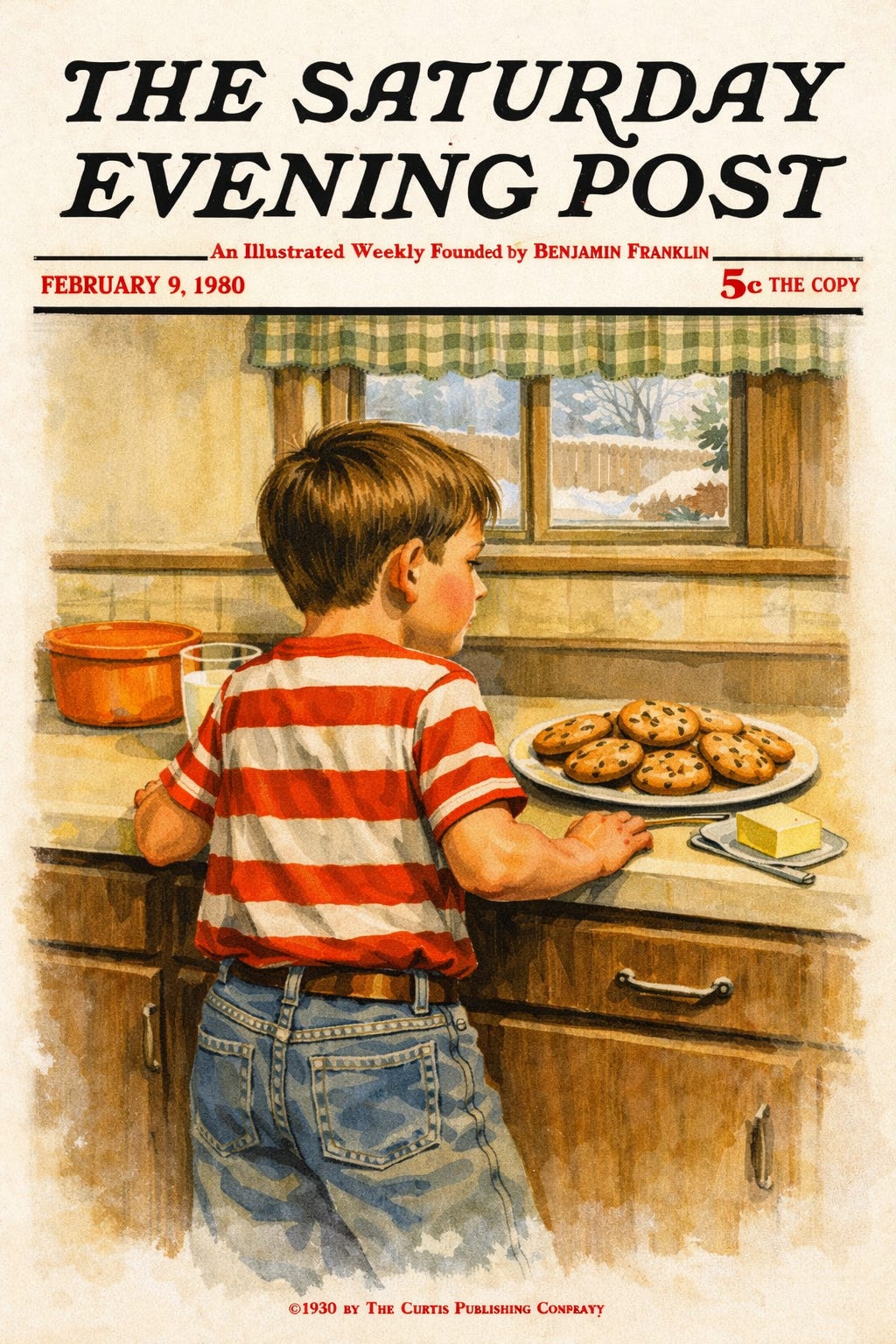
Boy, those fresh-baked cookies sure look like they turned out well, Ms. Whatever.
One doesn’t ask for what one wants in polite societies. It’s better to imply it, dance around the topic, and hint at the desire for something from someone. Let others decide if they are the ones to deliver.
This is low-risk, high-reward asking. If I get what I want in that situation, it’s at no risk to my ego. I don’t have to cope with rejection or worse, judgment.
This was all so problematic for healthy relations with women. Later in life, alcohol and drugs were useful. Even without a drink in me, alcohol gave me reps in being forward, but never so forward as to ask for someone’s number. Never enough to state my sexual wants.
At the time, I couldn’t have articulated why I couldn’t ask for what I wanted. I didn’t even know that this was a dragon worth slaying. Confront the fear, and overcome it? Scary.
The problems this caused extended beyond women. Until I figured it out, not asking for what I wanted hurt me in professional and interpersonal relationships as well.
The cost of this
The consequences, I came to understand, ranged from lonely to dangerous men, with many points of dissatisfaction in between.
The cost of all of this was so much lost opportunity to be a young man, take my lickings, and develop emotional resilience to rejection. It was also the abject loneliness I felt as a confused young man.
It would be my thirties before I’d get over any part of this.
A couple of years ago, still in my forties, I read the book No More Mister Nice Guy, by Dr. Robert Glover.
Another man had recommended it for my work as a coach working with men. Even though much of what the book proposed felt like conquered land for me by that point, it struck me that the book proposed a real problem for many men. It accurately described the boy and young man I’d been.
The consequences, I came to understand, ranged from lonely to dangerous men, with many points of dissatisfaction in between.
This was where a younger me had failed to understand what was missing from my interactions with girls and later women.
A central component of Glover’s book is covert contracts. Once I learned about them, I started seeing them everywhere. There’s a central problem with these agreements. Only one party is clear about them.
This was me tickling my friend.
It was me in my professional life, at least in the earlier part of it.
It was me, inebriated, with all bets off.
What this is like at 51
It doesn’t feel like I’m the model.
At this age, it would be so cool to brag about how far I’ve come, how sharp my want-stating has become. It would also be untrue, but it’s fair to say I’ve gotten better.
Fair, but not totally true. I still struggle to articulate my wants, even when I know them. I’m still afraid to climb out on that limb. I still enter into covert contracts. All the time.
There are still friendships left behind, like Tammy. How many friendships ended over this, I’ll never know.
My salvation is found in the work I do with men. There is this teeny-tiny territory of change I own outside of my self-development. It’s with men, who in their professional lives often have no trouble asking for what they want, but struggle to do so in their personal lives.
When I’m in dialogue with a man, either professionally or personally, I make a point to acknowledge when he can identify what he wants. I’ll even frame the statement in terms of my own want: “I want to acknowledge something you just said if that’s okay.”
Even better, when a man clearly states those wants, I make a point to celebrate in the most genuine, low-key way.
Most men pause when I do this, either because they think I’m making a big deal out of something simple or because they actually realize that what they’ve done was hard to do.
My hope is that I’m connecting with something in other men that learns, remodeling it just the tiniest bit. I hope that one-by-one, we—as those of us who get this—can inoculate men from this confusion by being the model and by celebrating success.
Honestly, though? It doesn’t feel like I’m the model.
Thanks for being here.
~Damon
I was lucky to get over this in my mid-twenties when I converted to Islam. I found that the laissez-faire attitude of morality or do no harm principle or tolerance of everything except intolerance really just makes wishy washy men who tolerate (nearly anything) unless it directly harms them.
With relationships its easy to let a lot go or leave a lot unsaid because if no one is hurt by it, then why rock the boat and risk capsizing the ship. Islam gave me an ideal to work towards and hard red lines set by God that I had no right trespassing or allowing a future spouse to trespass. I finished grad school and within 2 years I was married, within 3 I was a father. I got what I always wanted, but only when I knew what to ask for and what to stand firm on. All praise is to God!
Glad I found this dude