


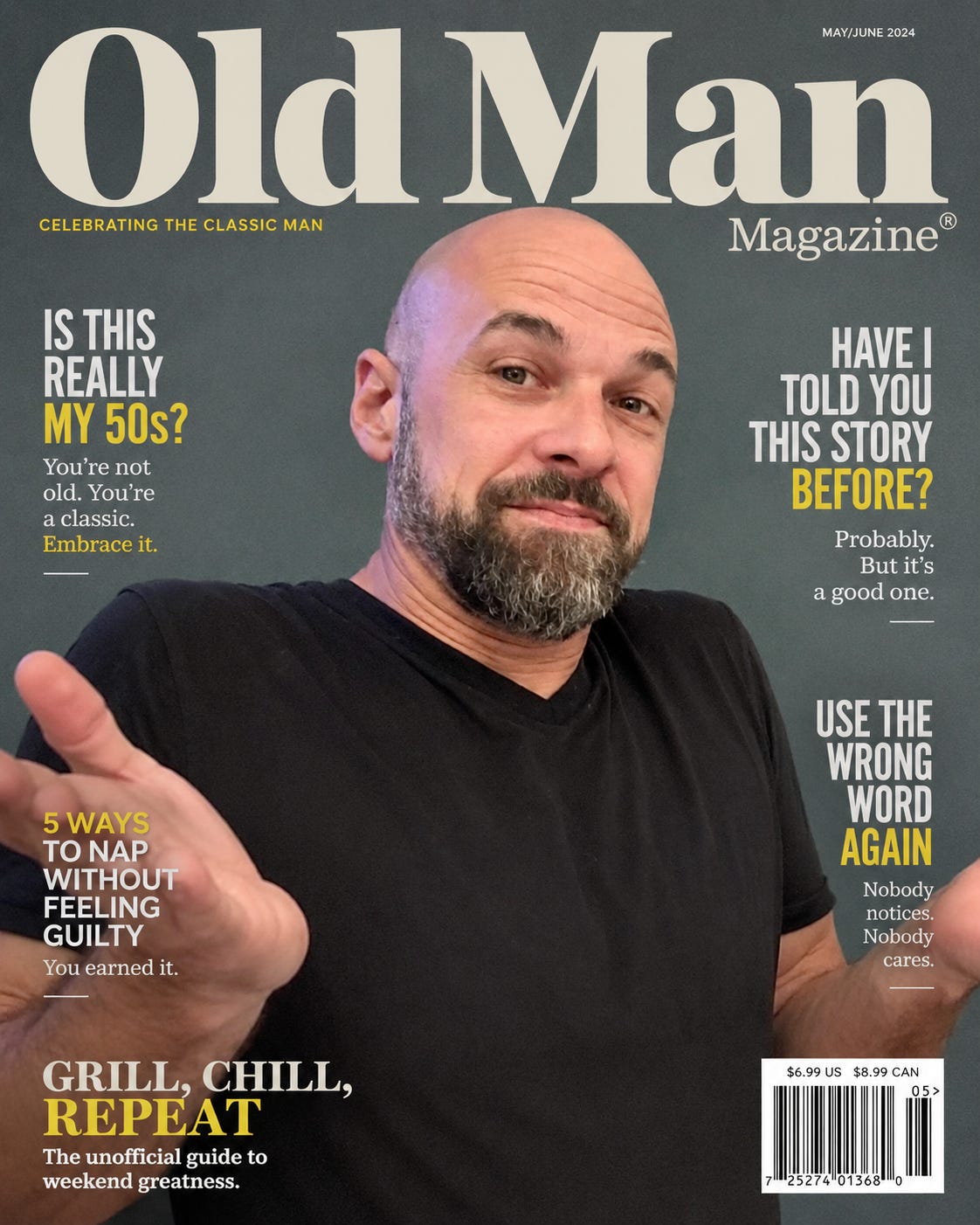
When I WhatsApp’d my friend JJ the other day, I mentioned that “I know I often share things more than once,” but that I was sure “I’d not shared this before.”
Wrong.
“Sorry to report, brother, but you did—in fact—already share this with me,” JJ replied.
This is not entirely new, but the incidents seem to be increasing over the last few years.
For the record, I’m 51 now. This feels a little early to be experiencing memory issues. If I were 80, even 75? I would expect some lapses, but at 51? Nah.
What I’m starting to suspect is that this is actually pretty normal for people in their 50s. It’s just that nobody talks about it. We try to hide it, but not super well. It peeks out in gaffes. I keep calling the little CrossFit corner at our gym “The Group X room.” No amount of self-criticism and cursing stops it.
In related news, Cristina (my wife, for those who are new here) started perimenopause soon after we met, in her thirties. She’s now postmenopausal, so I’ve had front-row seats at every stage.
Memory issues are often part of the symptoms, or so we think, but I wonder how much of it’s actually just aging.
Old age starts as early as our thirties.
What’s being asked of me is to let go of the need to change circumstances, to find something like love and acceptance of what is.
Arthur C Brooks has written a couple of books on this. From Strength to Strength is the one that comes to mind, the part where he enlightens the readers about when “old” really starts.
Spoiler alert, it’s not your eighties. It’s also not your seventies. It’s not your fifties.
Old age can start around age 35. If this is true, some of the oldest Zoomers have about five years until something shifts.
On average, the peak of creative careers occurs at about twenty years after career inception, hence the finding that people usually start declining somewhere between thirty-five and fifty.
Brooks, Arthur C. - From Strength to Strength: Finding Success, Happiness, and Deep Purpose in the Second Half of Life
Some are more fortunate.
To be sure, I looked around to see what other experts had to say about this. The second hit in my search results slapped me right in the gobbler:
Many people begin to notice changes in memory by around age 50.
Harvard Health Publishing (Aug 27, 2020)
This brings me to one of my most cherished acronyms: FFS
This is not something I’m making up. This is the bleeding edge of memory decline. Oh, nothing alarming. It’s just here, and what am I to do about it?
Cue all the bros suggesting neurotropics, sleep, exercise, intermittent fasting, micro-dosing, and hyperbaric oxygen therapy.
Hey, thanks, bros. I appreciate the intention, but I check more wellness boxes than most Silicon Valley CEOs.
All that is to say, I don’t believe there’s much else I can do technologically that will make my situation better, not enough.
What’s being asked of me is to let go of the need to change circumstances, to find something like love and acceptance of what is. Simple concept, but let me be the first to say: This is not easy shit.
Do I know something like this already?
My whole life, as is often the case with many men, anger has felt like a problem.
Rage is a feeling I’m familiar with, and perhaps a better model for talking about and confronting memory loss.
My whole life, as is often the case with many men, anger has felt like a problem. From an early age, I can remember feeling anger that demanded expression. I can remember noticing that it wasn’t just that I felt anger. I wanted the world to see just how angry I was. I wanted to externalize it.
This unnamed need has led to many instances of regret, throwing objects, slamming doors, and committing adult-sized tantrums. It’s the stuff of shame. It’s also often felt uncontrollable.
What I’ve come to understand through a variety of practices, Tibetan meditation, parts work, and constant insight inquiry, is that there is a very real part of me wanting to be seen when rage shows up.
Reconciling that part has felt mostly like failure, but I’ve come a long way. It wasn’t just about calming down through meditation. I can point to three major contributors that have shifted the experience of anger for me.
Learning to get space in whatever way possible, identifying and contacting the somatic (body-felt) quality of the rage, and practicing love and appreciation, in this case for the angry parts of me.
That last one is the hardest.
Can you be with it, man?
This isn’t just sloppy advice; it can be dangerous.
There’s a popular phrase being bandied about by the influencer crowd, inviting us to “be with” difficult circumstances.
It’s about the last thing anyone should say to me when I’m enraged, not if they value their life. I don’t think most of the people touting this advice even know what they mean by “being with” something.
This isn’t just sloppy advice; it can be dangerous. For folks living with trauma, even the lower-case-t version, being with something difficult can result in catastrophe without proper guidance.
Thankfully, my life has been mostly trauma-free. I’m able to notice body sensations without triggering anything.
In case you’re curious, rage arises mostly as the sensation of a hand gripping my esophagus, the finger tips digging in behind the passageway. It’s hot and rising, like acid reflux. I can also feel it like the hands of a large man gripping my trapezius muscles.
What’s not obvious is that noticing these sensations is the fastest exit ramp out of feeling the rage. When I have the wherewithal to do this, attention drops out of the rage narrative—the story I’m telling myself over and over about why I’m mad—and starts contacting the actual physical arising of the emotion.
Something like this is what I suspect is being asked of me with memory.
What does moving forward look like?
Ultimately, we have to give it all back.
What might it be like to disengage with the story of my memory failures, the “Oh my god, is this the beginning of the end? Am I falling into early-onset dementia?”
I mean, maybe? And there’s a case to be made for talking to my doctor. Any real solutions to medical conditions would require something more than attunement to the unfolding now. There is no spiritual bypass for ailment.
Meanwhile, there’s a… something like noticing the handgrip on my throat. There’s an available peace in being with this present feeling of what it’s like to witness my memory fading.
This is what I’m being invited into. I just seem unclear on where to find the doorway.
Ultimately, we have to give it all back. Whatever it is we think we had was only borrowed, and never ours in a permanent sense. The sooner we reconcile ourselves to this truth, the less we’ll suffer along the way.
There is a version of the story where we empty our vaults of everything, real and imagined, smiling as we do it. It’s a seemingly willful leaning into something uncertain, but inevitable.
Like old age, it’s coming sooner than we imagine.
Sometimes I feel like it’s right here.
Thanks for being here,
Damon
You know, I feel honored to be a part of this piece in some way. Which points to how much I like being your friend.
My sense is that you're pointing to two truths at the same time - a problem can be both invitation to a solution to that problem, and a different way to relate to problems in general that changes the center of gravity for your experience of being human.
Memory challenges can potentially be fixed or at least softened through medical intervention, but there's also a way to do a "vertical development" move of relating to what comes up around that issue (in your case, rage and shame) that allows you to live from a more grounded, conscious, deep place. That vertical move creates a change that is enduring and ripples out to other aspects of life too. Something that makes the roller coaster of being alive a bit more gentler to experience.
I also assume that this vertical move of learning to relate to experience with more gentleness and care expands choice - how one can respond to this and future situations with increased grace.
All this to say - bravo, brother. Bravo for courageously looking at that which many are not even consciously aware could be looked at, and staying with the discomfort to allow yourself to sink more deeply into who you are.
Love the magazine cover, Damon.
The memory stuff is real.
It's fun times in our household. I am peri-menopausal, and my husband is a very stressed 54-year-old lol. Work stuff - too many meetings - too many details.
We usually have a trivia night where we guess the song, usually from the 80s or 90s.
A light-hearted attempt to make fun of a situation.
Happy Tuesday to you.