


Whereas all of my former claims about self-worth will ultimately rise and fall over time, our innate value will not. Presence is the big clue.
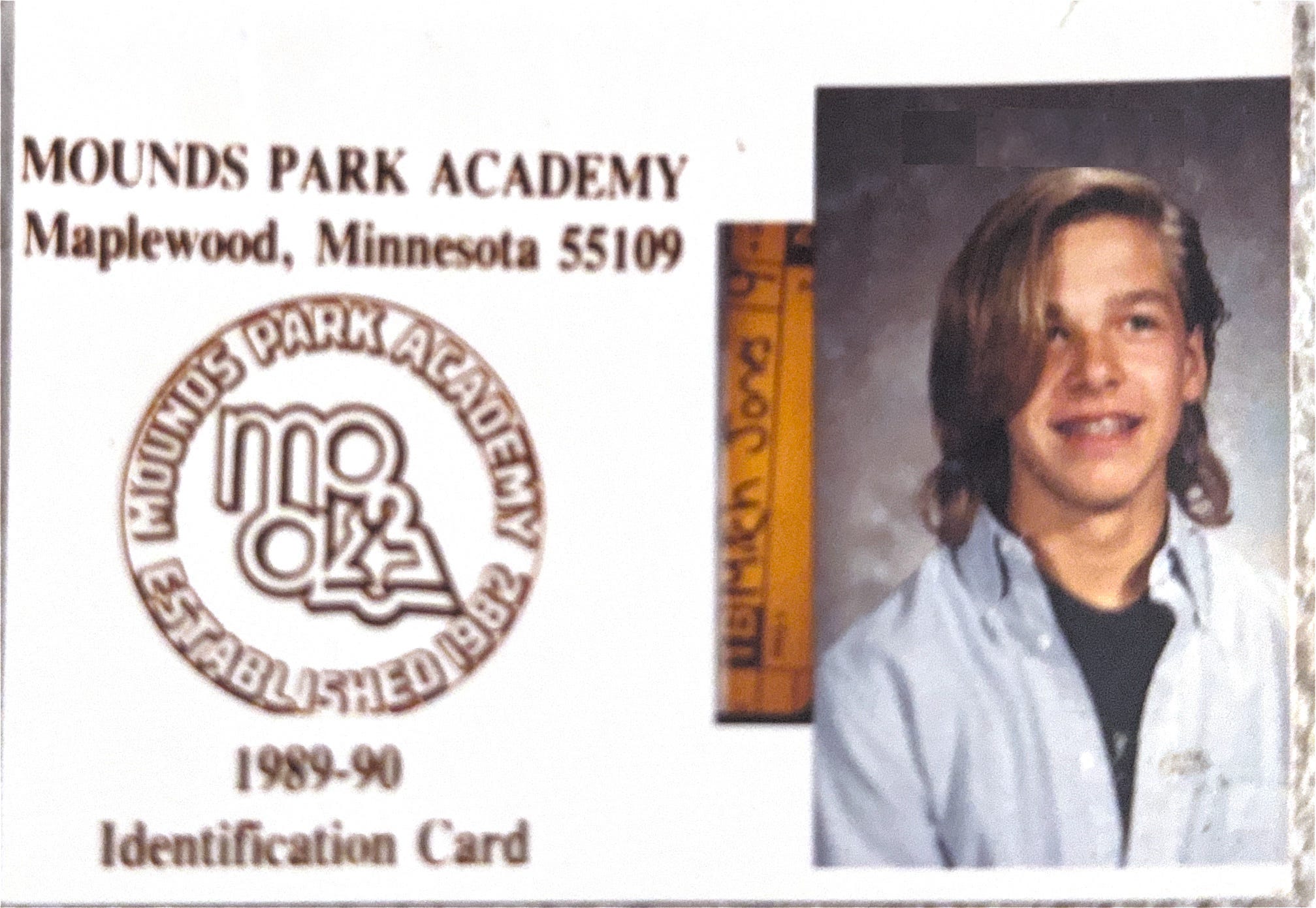
Pushed into a K-12 private school at age 14, this public school punk struggled out of the gate. It was my freshman year. I was there because I’d been failing out of the previous system.
What made my new school hard was that the students there had all known each other since grade school. That, and they all came from money. I came from a broken middle-class home, where my mom worked two jobs to send me to private school.
Early on at the new school, in an effort to win the affections of my new friend, Jeff, I joined his efforts to pick on another boy. The boy was obviously gay, but closeted in the most ‘90s kinda way. We were complete assholes to him.
Days later, my English teacher, Richard, asked me to talk to him after class.
“This boy you were teasing in study hall the other day,” he said, pausing for effect as I sank deep into my seat. “Do you understand that you’re hurting him?”
This simple idea hadn’t occurred to me, which piled awful onto awful. I’d been bullied myself plenty in the public schools. The shame welled up on my cheeks like tomato soup, scarlet and steamy.
That was all it took.
In short order, I’d come to befriend the boy and, in time, become an outspoken advocate for gay rights. Richard took me under his wing, too, acting as a mentor and something like a surrogate father in later years.
Anyone who sat in one of Richard’s classes knew this about him: in life, Richard Meacock showed the fuck up, as a teacher, a mentor, a father to his daughter, and to any student who needed one of those figures in their life.
He was present. He was an embodied presence to put it more clearly. From the vantage of middle age, I now see that this was his value. It’s all of ours, really. Most of us just don’t know it.
Let’s back up a second.
For months, I’ve been wrestling with self-worth via this newsletter, and I’ve had some moments of insight that I’ve shared.
If you’ve been following along, you’ll be aware that I’ve written three essays on it, each attempting to refine its measurement.
In the first piece, What’s My Worth as Man?, I asserted that anyone who lightens the burdens of another is valuable. Nice and neat, but not satisfying.
In the follow-up, My Self-Worth Portfolio, I suggested that men would be wise to keep a diverse portfolio of self-worth investments. That seemed like a better plan.
And finally, in Self-Worth Really Isn’t About Me, I landed on the value of other people in our lives to reflect any notions we might have about our self-worth.
Each of these claims seemed a little deeper, but each was really stuck at the surface. The problem, as I see it now, is that each defined self-worth from somewhere out there.
In truth, the most valuable source of our self-worth was always right here. One could call this the tap root of our self-worth: Our human value.
This is the deeper truth as I see it now:
Value was already a quality of being for each of us, from before we existed.
Whereas all of my former claims about self-worth will ultimately rise and fall over time, our innate value will not. Presence is the big clue. It’s an idea we’ll come back to, along with what I mean by “from before we existed.”
In many ways, Richard Meacock was the embodiment of this truth, but I was not ready to see it back then. It’s probably true that one can believe this without seeing it, but it also seems true that seeing it is everything to living it.
Please, I know this is a little esoteric. Bear with me. Even if you come to disagree with me in the end, I promise to make a solid attempt at explaining this.
Lastly, before we dig in. There’s little daylight between any human and our respective hungers to define our worth. That, and our shared confusion about where to find it. Men, however, have a particular penchant for seeking it externally, and then collapsing when those sources crumble.
Arguably, I could be speaking to all genders, but I must admit that men are central to my concerns on this matter. Take that as you will.
To begin, the first thing we need to understand is that everything changes, even stuff that we call “permanent.”
Nothing is forever
In short, anything “out there” will never make us feel happiness or satisfaction in any kind of permanent way. Most external sources of satisfaction are barely durable, fleeting at best.
For the record, the concept that satisfaction will never come from somewhere outside of experience isn’t my original thought. This is core Buddhist philosophy on happiness or satisfaction. One needn’t sign up for Buddhism to get this.
In short, anything “out there” will never make us feel happiness or satisfaction in any kind of permanent way. Most external sources of satisfaction are barely durable, fleeting at best.
It’s how the first bite of the chocolate gelato makes me wonder if I wouldn’t have actually preferred the Stracciatella. It’s the same as how the first line of cocaine was exactly the moment I started wondering about how much more satisfying the next would be.
Again, this is logic borrowed from Buddhism, but not exclusive to it: “Everything that rises will fall,” or “Everything that has the power to live will die.”
Most people get all of this intuitively. For men who view their careers or investments as their source of satisfying self-worth, they imagine that the trick to the game is daisy-chaining their efforts and sources to cover all the gaps, thereby never needing to question their worth.
This is what I was trying to do with the essay, My Self-Worth Portfolio. This method can work, but only at a certain depth of existence, and it’s not impenetrable. I would argue it’s only slightly more sophisticated than believing my career success defines my self-worth.
What’s smuggled into both ways of navigating life is that all of this action is driven by an undercurrent of doubt, surging and falling below the deck in an endlessly threatening cadence.
Just one iceberg could bring it all down. Where would worth come from then?
In the essay, Self-Worth Isn’t Really About Me, I really believed I’d stumbled into what was missing from the portfolio model. We need other people to feel a sense of completion with our self-worth investments.
This is still valuable at a certain depth. It's certainly more sophisticated than my previous claims. It brings people together, right? That’s virtuous. Right?
Yes, and yes. It does. This model of self-worth can really work, but not unfailingly. It’s still a collection of external sources of value, susceptible to the same laws that govern birth and death, and all transactional.
In a world where transactions are the only source of our human value, we’re all doomed to suffer for long periods of time, and some of us for life. There must be something deeper than this, is the thought I keep noticing, and what is it? is the question I keep asking.
The answer came to me recently in a lecture from a man named Steve March.
Value is already innately present
Like light, which is valuable even when it’s not present, so too is human presence.
Unless you’re a coach or philosopher, and even then, you won’t know Steve March. He’s the founder of the Aletheia School of Coaching, a school that seeks to upend the self-improvement standard in coaching.
What Steve said in a recent training, where he was one of the facilitators, blew my mind. It also made me think of you, dear reader, and this dragon I’ve been attempting to slay.
I’m paraphrasing, but what Steve said was something like this:
“Value is already a quality of being for each of us, from before we existed.”
If you’re like me, the first thought you had was… “BULLSHIT.” But, since then, I’ve been investigating this claim through dialogue and thought experiments.
What Steve is really claiming is that we are born with value, and that this value doesn’t go away just because we made unwise choices in life or because nobody told us. Like the luminosity of light, it’s not something light does. It is what light is.
With humans, we could call this humination, our human presence in any given context. Like light, which is valuable even when it’s not present, so too is human presence. In fact, it’s arguable that both are even more valuable when they are not available.
If that metaphor doesn’t work, try this thought experiment:
Imagine being trapped alone on an island indefinitely, and how the non-presence of another human might cause a well of desire to rise so uncontrollably. Imagine finally seeing another human strolling down the beach after months of solitude. Imagine how that might feel, even before you speak to that person.
We generally take presence for granted, but this thought experiment seems to illustrate clearly how we might feel if it were gone, like the rising sun after the darkest night.
Every being, by virtue of existing, is an expression of this fundamental worth.
Don’t worry if this isn’t landing for you right now. This is me officially recommending you hold onto it for later in that case. Here’s why.
Once we see this, we may not need the other stuff
When the career falls apart, when all our virtuous investments crash, and when we find ourselves without another soul to reflect our experience, we’re still valuable.
A friend recently shared something difficult he’s going through in a voice note, citing that he just needed to vent. He was struggling with a disabled person in his life. Making matters worse, the real problem was how a part of him hated the part that was struggling.
With his permission, I reflected back what I heard him saying, offering how he might reframe the situation and give himself some respite. He was really coming down hard on himself and needed an advocate.
This move, tracking (reflecting) and offering, is something I’ve picked up from coaching. I also use it when talking to people outside my practice. For my friend, it made him feel so seen; he burst into tears listening to my message. (Not my intention.)
Most would assume that my worth in that exchange was my being a coach. Not quite. My value to this friend was my humination, my human presence, the same presence I saw in Richard Meacock.
Like darkness being an ideal environment for showcasing the value of light, coaching is an ideal medium for humination, our innate human value.
Humination doesn’t trade on anything. It’s not transactional. It just is. It was valuable before we were born, and it will remain valuable after these bodies die. It cannot be taken from us, and it remains valuable even if we’re not practicing it.
Some of us practice it more skillfully than others, but all embodiments remain valuable.
When the career falls apart, when all our virtuous investments crash, and when we find ourselves without another soul to reflect our experience, we’re still valuable.
You are valuable right now for your own humination. Your very presence as you read this text sheds awareness on what I’ve written in a way that no rock, animal, or entire solar system can do. Not as far as we know.
So let me express gratitude to you for being here, for seeing me.
It’s so very meaningful to me.
~Damon
Reading this made me think of eulogies. I've written and delivered many -- too many -- for parents, relatives and friends -- and each time I do it I strive to reveal the essence of that person in some way. I believe what I'm calling essence you're describing as presence...or maybe it's the impact of a person's essence on me and others. This is a beautiful, insightful piece. If we all worked harder on the inside of ourselves (vs. the outside) we'd all be better off.
I really appreciate the focus on value and finding value in ourselves as an innate expression of our being. I also think this plays out in how we find the values that allow us to draw out our inner value and express it to the world.