


☝️ If it works better to listen, I recommend the audio version above. Many of my readers are actually listeners.
The wellspring of rage

August air is hot and thick in the Caribbean. The sun’s a killer by about 10:00 am. As such, standing on concrete, facing a concrete wall, feels like standing in a Jiffypop popper over an open flame.
Anyway. One can’t live indoors all summer, and it’s impossible to practice volleyball in the dark. That’s why I was standing there that Monday around 9:00 am.
As I swung at the ball, something about my position was off. The ball didn’t bounce the way I expected, making it impossible to pop it up from the rebound.
What I then noticed, thanks to a twelve-year practice of meditation, was the physical manifestation of rage rising in the body.
Crabbiness, irritability, and full-on raging are feelings familiar to most of us. For men, however, anger is a problem. The feeling isn’t the problem. It’s how we express it, but that’s not how we see it.
It would be ideal, as one man in my men’s group shared, if we could simply NOT have that emotion in the first place.
Just don’t have anger? Oh! Nice. That sounds lovely. How do I get me some of that? Can I have a switch installed in the brain, er some’n?
The problems for men with anger vary, but the primary concern is violence. Men index higher for brawn and testosterone. Sprinkle a little piss and vinegar into the mix, and things can get scary.
As far as I can tell, what men want is to be able to experience and leverage their emotional state of anger for positive outcomes, but also to feel seen for doing so.
That last part is the one that means so much. It may be everything to this essay.
Seeing anger
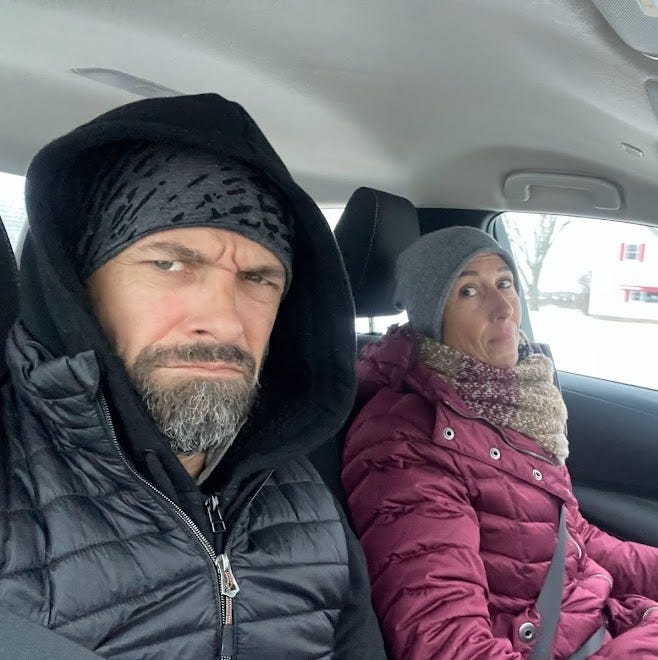
Sometimes, I wonder if feeling seen for our anger is what we want so badly that the idea of leveraging it for positive outcomes ranks a distant second.
What happens too often for men is that we don’t feel seen for our anger until we blow our top, and then nobody is happy, quite literally. Then it’s all retreat, shame, repent...
It makes me wonder, if we could feel seen for our anger before the top blows, might we stand a better chance of leveraging anger for positive outcomes? It’s hard to run the counterfactual on this, especially when the examples rank close to zero.
To avoid the anger explosion in my own life, I’ve tried to create the perfect world where nothing provokes anger in the first place.
Fun fact: Eliminating anger-provoking moments is not possible.
We get sick. We get run down. There are many contributing factors to the feeling of anger, like an uncooperative volleyball swing.
Standing in the full sun of the Caribbean, fuming, I did what I’ve learned to do at such times. I called it out.
“Ooh,” I said, to nobody because I was alone. “That’s some intense anger for something so trivial.” I continued, “It feels like a hot swirling sensation in the esophagus, toward the front of the neck, scraping upward like little animal claws.”
Exposure to Buddhist philosophy has been instructive on this front. I’ve learned that an acute awareness of the physicality of anger (or any emotion) can have an evaporating effect.
Standing in the August sun, it did just that. For a minute, anyway. Then the anger rose again.
The Buddhists would argue that it rose as a new, standalone event. Either way, anger was present again. What also seemed true was that I was finally succumbing to the virus my wife brought home last month.
This is what happens to me in the early days of a virus: anger that seems outsized for the offense. I could have reapplied the act of seeing like sunscreen, but I was on a twenty-minute timer, and I was trying to improve my VO2Max.
So, I surrendered to practicing volleyball in a state of anger.
Anger in my life

As a coach for men, whether I want to talk about it or not, anger is often on the menu. So is shame, but that’s a whole ‘nother essay. Suffice it to say, shame shares territory with so much of our suffering, including anger.
Tangent: Recently, I started reading a book on anger, Why We Get Mad, by Ryan Martin. He has a Substack, which is worth your time if anger piques your darker curiosities. Weird flex or transparency about my bias, you decide, but I once knew the high school version of Ryan. To find him writing about something I’ve come to find so gravitational has been strange.
Anger, as it is, has been a prominent figure in my life since before my formative years. I come from angry genes. My Mother’s brother, Uncle Jack, was often a total ass to me as an adolescent. He could also be a sweetheart at times, but his bullying was hard on the sensitive boy I once was.
Raised in a world before ADHD diagnosis, I spent a lot of my childhood “throwing fits.” I was frequently in trouble for not minding my parents, and felt disempowered by the world. It seemed set against me, powered by evil forces. I would often throw toys that “didn’t cooperate.”
As a teen, this turned into throwing my skateboard when I couldn’t land a trick, or slamming doors, punching holes in walls, and generally scaring my high school girlfriend.
Sadly, being scary didn’t stop me from being bullied. It made me more of an emotional target. I don’t just mean my Uncle Jack; I was bullied through adolescence and into my teen years.
There were many douchebags, but my main bully’s name was Kit Riter. He once slapped my face repeatedly on the backside of a garage just after sunset. I didn’t know how to fight, and it wasn’t allowed in my parents’ home, so I didn’t dare try.
Once, I punched a sixth grader in the face on the bus ride home from summer school. I was in the third grade or something. He’d been picking on me, and the punch stopped him. When I proudly told my parents later that day, they were not impressed. Fighting is not the solution, I was told.
Instead of fighting other boys as I aged, I would come to fight with myself and my own abusive behavior.
Abuse begets abuse

We know that abusers are often abused, but not all abuse leads to abuse of other humans. Abuse comes in many forms, like self-abuse or chemical abuse.
In recovery from alcohol and drug abuse at age 37, I would discover the dots connecting bullying to my drinking, tied inextricably to a bed-wetting problem that lasted too far into my teen years. It was this quiet, bruise-free ego damage percolating on the back burner of my life, undermining my confidence.
Anger was the only acceptable pressure valve on the whole system. I needed a way to stem the pressure before the top blew. Drugs helped. First weed n’ shrooms, then wine, and eventually booze and blow would cover all of that shit.
It’s not that I didn't get angry when I was drunk. I just didn’t care that I was angry. Not my problem. It’s your problem, ya bed wetter.
It took a week of sobriety to stop thinking my life was over. It took six years to stop believing a shot could make things better, and ten years to really feel like sobriety was something durable. No level of anger (or any emotion) undermines sobriety for me these days. Not yet, anyway.
Booze was a bubble-gum solution to the problem. I had to get sober and find new ways to work with it to have something that didn’t feed back into the problem the way booze did.
The power of noticing

There will be little I can do to stem the tide of anger arising in a given situation. That doesn’t mean trying is a waste of time. Reducing the sources of our pain is wise by any ideology. It’s also wise to train on how to respond to those sources in some fashion.
This is what I’m doing when I call out what’s happening physically, sometimes referred to as somatics. I’m trying to train a healthier response. One can also summon provocations to train without the mixture of unawareness that usually accompanies anger.
In our house, the dogs know I’m angry before I do. I find out by the way they tuck their ears back. This, as I’ve learned from Martin’s book, is the pre-anger state. This model, borrowed from the research of Dr. Jerry Deffenbacher, adds a more detailed model of what I already knew from Buddhism.
Buddhist teaching and practice had already taught me that I’m not angry because an event happened (or didn’t happen). The brain was already in an agitated state. The event is simply an outlet for that agitation, but it’s not the source of it.
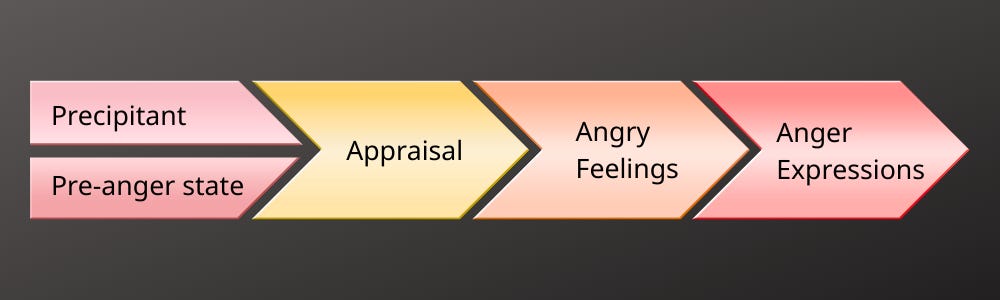
If I understand Deffenbacher’s model, my pre-anger state was the incoming virus, dragging me into my worst self. The precipitant was the “uncooperative volleyball” or my failing body position, same.
Buddhism sorta skips over the appraisal and feelings parts, and heads straight to the more concerning aspect: expression.
In short, I appraised that I should be able to practice with more precision, and that this failure was worthy of feeling angry = angry feelings = hitting the ball a little wild.
This part, the expression, may be the only part where we have some agency.
What went well for me, at least for a minute, was reducing anger to its physical manifestation. In Buddhism, it is taught that we can respond in one of two ways to aversions. In this case, the feelings associated with anger are the aversion.
We can…
Avert attention from the feelings (by drinking or hammering some nails into wood, hopefully not at the same time) or…
Turn attention acutely toward the source of the aversion, studying it like a scientist, curious about its very nature.
The first one works well and works best when the precipitant is too strong or the mind is untrained. Men intuitively understand this when they turn to their work during times of strife. I knew a man who had four daughters with his wife, each a result of trying to have a son. He kept a dirt bike for riding and tuning when he felt the aversions of male solitude.
Ideally, I want to spend more time on tactic number two. I would prefer to have a detached curiosity about the aversions of life. The challenge to this fantasy is that life is dynamic. It’s unpredictable too.
There is a third, unmentioned, and unwise response to aversion. It’s the one we most often fall to when we’re not our best selves. We attach our sense of self to feelings and react as if our very self is under attack.
This is where men can get into trouble with their anger. This is why the man in my men’s group believes his anger is a problem.
It’s not the feelings. It’s how we express them.
We are not angry, not episodically. We feel anger. When we’re unwise, the claim, “I’m angry,” is somewhat accurate. In such cases, we’ve embodied the feelings in an attached way. There appears to be no separation between feelings and self.
How to practice

For me, volleyball has become a great place to practice noticing anger. The feelings show up often. Noticing their somatic manifestations has been instructive.
Noticing body sensations is not easy for everyone, though. Some people, especially those who’ve suffered serious trauma, struggle to notice sensations in the body. For those people, I would suggest two courses of action.
Seek help for the trauma. Yep. I mean therapy.
Meanwhile, start with what’s available to notice.
Even superficial sensations can anchor the mind to details like facts, overpowering feelings, long enough to help detach from them.
Volleyball works for me because it’s an environment where I can slow things down.
For some, that environment might be rush hour traffic. It might be at work, reading emails. In such cases, there’s enough space to slow down and consider what’s happening. A bad example would be when you run into your childhood bully in a bar.
What’s possible to notice about anger is that it may arise about something worthy of our attention, something more critical than volleyball. Poet David Whyte argues that anger is really an expression of deep caring.
Stripped of physical imprisonment and violent reaction, anger is the purest form of care, the internal living flame of anger always illuminates what we belong to, what we wish to protect and what we are willing to hazard ourselves for.
~David Whyte
The feeling isn’t the problem. It’s our expression of it.
If we can manage the way we express the feeling, there’s a chance we can channel that pure form of care into something truly worthy. Injustice comes to mind as an obvious example.
I don’t mean action through rage. I mean action through the wisdom of knowing self because we’re noticing at a deeper level. I mean, a powerfully calm person speaking and acting like someone who knows themselves at the darkest depths.
I believe this is possible.
Thanks for reading,
~Damon
So… When and how might you practice today?
As of this writing, Tolernace of Men is a new publication. I could use all the help I can get moving my audience and gaining new readers.
It is my priviledge to offer this work for free, not because I don’t believe its worthy of payment, but because I make my money coaching. Substack is a soft landing into my world.
Thank you for sharing
It's always helpful to hear how other people handle o manage certain emotions. Some can be relatable while other ways are surprising. Great read.
Thank you for leading by example with your vulnerability here, Damon. I loved the observation that your dogs sense your anger before you do. This hits home for me, and I'd include my wife and my kids in the mix. I feel like so much of my personal work is learning to become the earliest witness!