


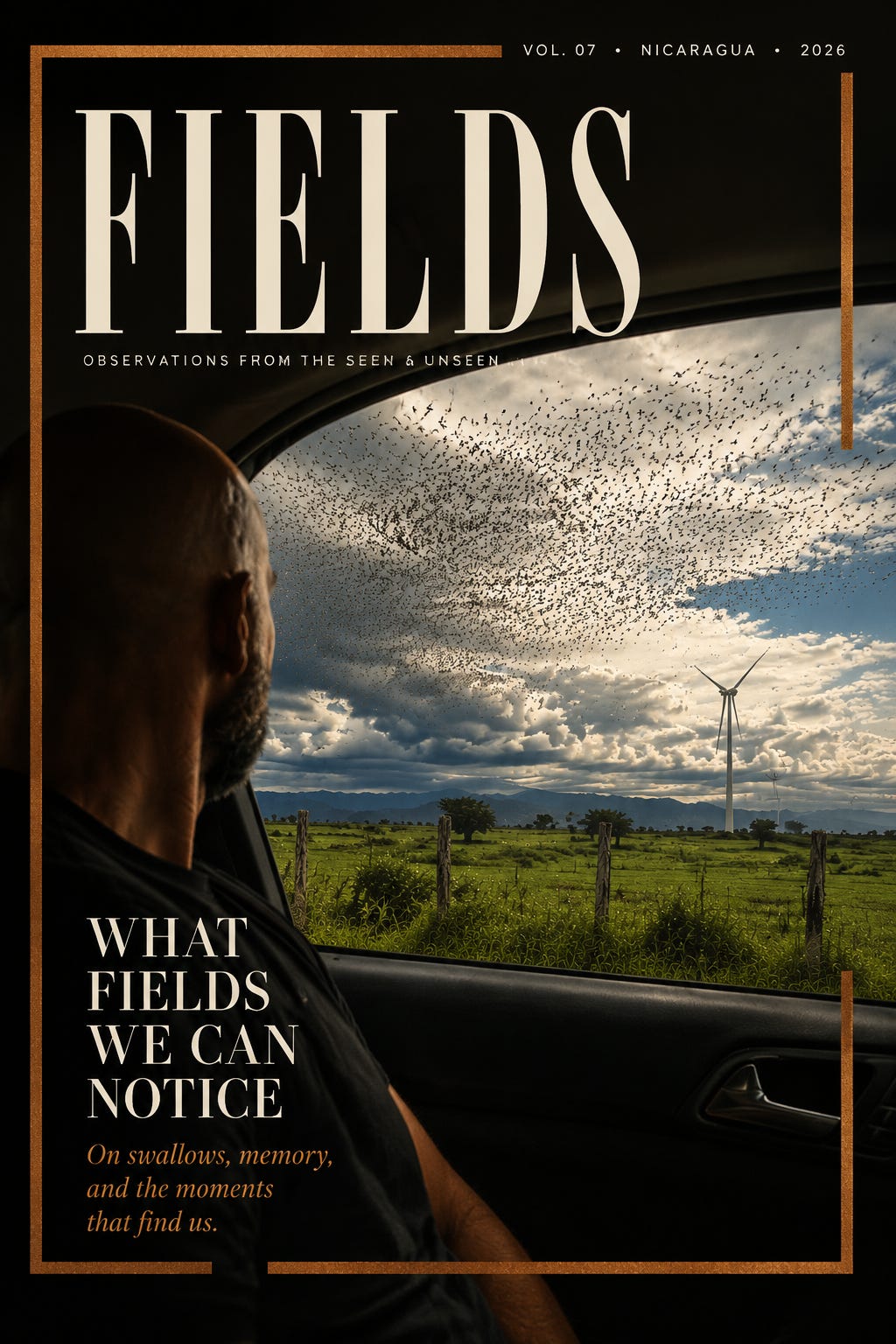
As the taxi driver floored it northbound up Nicaragua’s neatly lined and well-paved roads, clouds of swallows murmerated over the fields to the west.
There was something profound about those swallows waxing in the enormous volume of air rising from the crops below.
They seemed to sweep me up into the cloud. For a moment, I forgot the mission. We were there on a visa run, common amongst expats, but I might as well have been a swallow for the moment.
Can humans do this? Given the chance, surely we’d collide. We need the benefit of contact, like the way ballroom dancers lead and follow. Or maybe not. I’ve driven the 10 freeway in Los Angeles during the wee moments before rush hour turns it into a parking lot.
With or without turn signals (too often without), drivers predict the intentions of other drivers like their lives depend on it. Arguably, they do.
To call it a mad dash would lend an organizing principle where none exists. Oh, sure. There are lines on the road, laws, and a singular directionality of the traffic. One can assume a lot on logic alone, but there’s something else going on. It’s something I can’t quite name.
Related, in the 90’s, I read Gavin de Becker’s book, The Gift of Fear. The basic thesis was we’re capable of knowing much more than we give ourselves credit for if we can only notice all the ways knowing shows up. Recognizing fear is central to the book.
He uses the very example of freeway traffic to demonstrate how we know more about the future than we tend to assume.
We might not understand what we’re noticing, like how the brain can notice the most minor shift of a vehicle within a lane, but maybe we don’t need to. Do we imagine the birds are interpreting movement by those around them?
One bird at the edge of the flock notices that it’s getting close to an object or an updraft, and then out of self-preservation, it tilts a feather slightly to adjust. In a fraction of a split-second, the birds near that one move commensurately, and the whole cloud shifts in kind.
It’s beautiful, and mysterious. And. We don’t have to understand it to see this much. We also don’t have to understand it to experience it.
Lately, I’m starting to believe our experience of what’s happening in these murmurations isn’t limited to flocks or freeways.
One obvious example is how when we walk into a room, and we immediately notice a shift in something we might describe as “energy” or “the vibe.” It might not even be obvious in the moment, but de Becker would tell us not to ignore that feeling.
My rational mind prefers to assume there’s something we could know about what we were noticing, and I think de Becker would agree. Heck. I might like to replicate that awareness in the future. It could be useful to identify what I’ve noticed.
It’s just that, this level of awareness isn’t always accessible in the moment. Awareness often shows up more like a feeling, less like data.
While we were living in Costa Rica, during one of my mother’s annual winter visits, I taught her how to properly perform a few Olympic lifts. For a couple of months, she joined us at our local gym, where I would cue her.
One day, after leaving the gym, I had a sense that something was up. I’d even said as much to Cristina earlier, but I couldn’t name why I thought so.
So I finally asked Mother, “What’s going on?”
For a second, she denied it, and then caved.
“I guess I’m feeling homesick,” she finally blurted out, fighting tears.
Selfishly, I was relieved. I’d been reading the room correctly, and my fear that I’d done something wrong was abated.
De Becker would argue that there were signs I wasn’t able to detect, which is fine, but I didn’t need to identify anything concrete to intuit something.
Although the very rational parts of me object, I’m starting to talk about this as “fields,” at least in contexts where the audience won’t wonder if I’m about to burn sage or recharge my crystals.
Central to my role as a relational coach for men, I’m sometimes calling it the relational field. Again, audience dependent.
It may or may not be an actual field—I don’t need to know—but the model suits the circumstance neatly. There may be something worth noticing for future reference, but like a swallow in an undulating flock, it’s enough to recognize that I feel the shift. I don’t have to understand it.
In my work, it seems to be mostly a matter of noticing what we’re noticing. This can be tough in a world that feels clogged like an LA freeway at rush hour.
For many men, we tend to down-throttle what isn’t crystal clear. If we can’t wrench it or drop it into a spreadsheet, it’s not real and probably not worth our attention. We don’t even expend that much energy.
It’s like we don’t even identify that there’s something to ignore. What we could have noticed bounces off the atmosphere of our attention, swallowed by outer space.
My job, in wildly oversimplified terms, is often just helping them wake up to the field they’ve been driving past all along. It sounds easy, like “just look over there,” but there’s a kind of ocular blind spot at play.
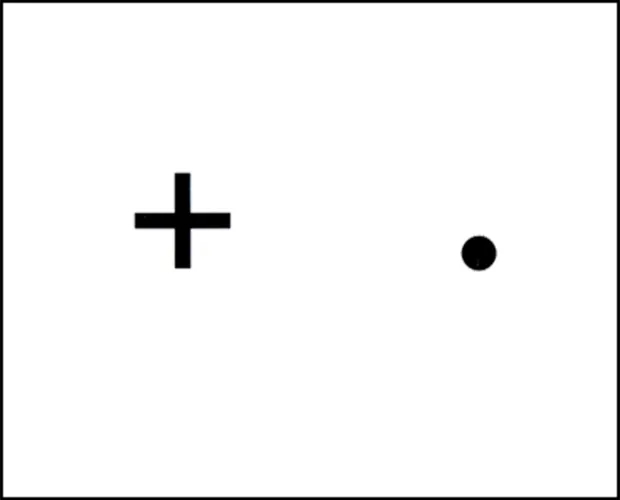
This is like the field. Some men might describe it as intuition. Others might call it “their gut.” That’s as close as some will ever get to recognizing there is a something worth knowing.
Still, we have a leg up on the birds. They’ll never notice the field the way we can. They’ll never need to build a concept, not even one divorced from proof. Which begs the question: Why would we?
What could be so valuable about recognizing a relational field arising in the space between the people who matter and us? Why might we want to know when they’re about to change direction?
Of course, I have my own answers to those questions, but like most of my answers, I’m sure I’ve got them all wrong, and I’m more interested in what others have to say.
Have you ever noticed something you might describe as a field between you and another human being? What was happening?
Thanks for being here.
~Damon
Calling all Betas
My friend and talking partner, Richard DAmbrosio and myself have been creating a course for men. We’re getting close to launching the beta, which means we’re looking for participants. The beta is four weeks, and best of all it’s exactly zero dollars.
If you would be interested in being a beta tester, DM me.
What a great piece. Thanks so much for this. Noticing what you're noticing is really what I'm trying to get guys to do more of as well. You've put it so poetically and profoundly here. I believe it's an important start.
The only thing better than reading this is hearing it read. It's truly beautiful writing and you make such a complex topic so palatable and easy to unfold. I've found that in the days since reading this I am trying to wake up in the moment and see what if anything I am sensing and being AOK if I don't understand.