


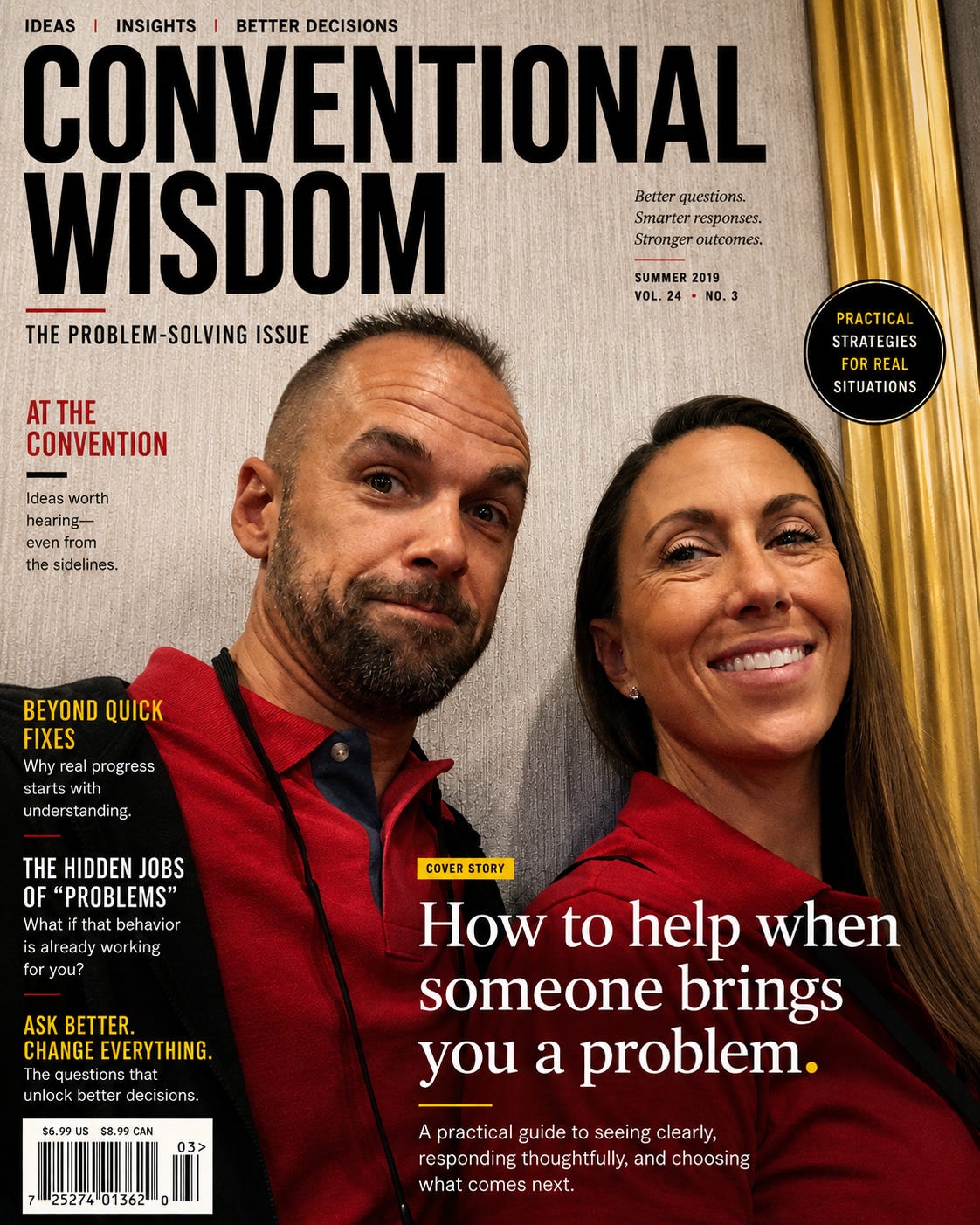
I’d been trained to overcome the fear of approaching strangers from early days in Big Fitness.
This was not where I was supposed to be. That much is obvious now.
I stood there with Cristina—the wife—by my side, clinging to the back wall of an impromptu auditorium in downtown Chicago. Scott Dikkers, the founder of The Onion, was sharing stories with a large crowd of fitness people.
This felt far safer than the convention floor, where I was supposed to be schmoozing. It was October 10, 2019, mere months before COVID would turn the world upside down.
At the time, I was still calling myself an email strategist, which was overselling my copywriting skills. To be more precise, I was styling myself as an email strategist for fitness organizations.
It made sense. I was good at copywriting, and I knew a lot about fitness since I spent most of the early 2000s climbing the ladder of the LA market.
That meant I also knew a lot about schmoozing, or so it seemed. I’d been trained to overcome the fear of approaching strangers from early days in Big Fitness.
“It’s a numbers game,” the more experienced membership counselor taught me about collecting leads from existing members. “You just ask everybody who walks by.”
I mean, he wasn’t wrong. I suddenly collected enough leads to get the sales manager off my jock. It was solid, white-knuckle advice.
Pretty sure I drank that night. I was drinking more at the time because I was trying to stop using cocaine and other drugs. I wanted more normal. Apparently, normal was the bottom of a tequila shot for me. Maybe three.
“Just to take off the edge,” I would say at the time, quoting some aggregate of movie lines.
But back to talking to strangers.
In the first few years of my time in fitness, I revisited this advice repeatedly: It’s a numbers game. Talk to many people, some will be cool, and a few will eventually convert.
It never suited me. Every time, something would rise up around my stomach area.
“You’ll get used to it,” would say my district manager. “It still happens to me some… gotta ignore it.”
A part of me did not like this, a very protective part. It (and other protector parts) would show up whenever I needed to approach strangers.
This part was not the problem. It was the solution.
It was the best solution my system could figure out to keep me safe from whatever pain it thought I couldn’t handle.
The problem with the problem is that the problem is deeper than strategy or tactics. It’s something complex, and complexity can feel hard. It might even feel scary.
So I just stood there against the wall at the convention. I mean, “I love The Onion,” I told myself. “I’d hate to miss hearing this guy share his stories.”
Plus, there were pastries and coffee. So.
Eventually, Cristina and I found our way out onto the convention floor, where I engaged in some dialogue with the vendors. After all, they had no choice but to entertain me. Not a problem. A solution.
Needless to say, I was relieved to get out of there. Chicago offered so many delights - food, sights, and the train out of town.
What this reminds me of is something I’d learned early in recovery, something I often surface in coaching men. Most people think their problem with drinking is the drinking.
The advice is clear in that case. Maybe cut back. Maybe quit. Maybe go to AA or something? Solve “the problem.”
But alcohol was never the problem. It was the solution. It was the best solution our systems could figure out to keep us safe from whatever pain they thought we couldn’t handle.
And yet, from the comfort of our social media portals, we onboard advice in the form of hacks, best practices, and strategies that address solutions as if they were problems.
Sometimes these strategies work, at least in the short run, but that’s nothing to say of their durability. Never mind that most strategies aren’t treating problems. Not really.
The problem with the problem is that the problem is deeper than strategy or tactics. It’s something complex, and complexity can feel hard. It might even feel scary.
But we’re complex beings, built for complexity.
… less like an enemy to be beaten into submission and more like an uninvited houseguest.
There’s a story I carry that illustrates an invitation into depth that’s so powerful, I’ve not been able to put it down. It speaks directly to this matter. Please begrudge me another story.
When Mingyur Rinpoche was young, he suffered panic attacks. The worst part was that he was a Rinpoche, which is something like royalty within the world of Tibetan Buddhism.
His father—a highly regarded leader—recommended to young Mingyur that he befriend his panic, an idea that sounds ridiculous on its face.
In his book, In Love With the World, Mingyur recounts the tale of sneaking out of his ashram to go live in a cave. This was very difficult for a man who had no money and had been attended to his whole life, but he did it, stealing away through a window in the night.
He nearly died, experiencing what many would call a near-death experience. Through trial by fire, deep meditation, and what amounts to a full surrender to his own demise, he figured out how to stop fighting his panic.
With a full acceptance of his nature, he learned to welcome his panic into his heart. In the book, he alludes to inviting it to tea, treating it less like an enemy to be beaten into submission and more like an uninvited houseguest.
What if the problems… were the best solution my system could figure out at the time?
When I first read this account, I couldn’t fathom how this concept worked in the real world. But the promise felt like unteathered freedom, the sort we all secretly pine for against our most challenging parts.
It begs the question: What if the problems I keep trying to solve were never really problems in the first place? What if they were the best solution my system could figure out at the time?
Panic was Mingyur’s system trying to protect him from feeling something scary, unaware that by its very nature it was creating something else very scary.
My drinking came from a part of me that saw only one way out, no matter the consequences.
What I wish I could do is tell you how to get there, how to push past all your apparent problems. For starters, I don’t think I’m there myself. Even if I were, I think this path is similar but wildly different for each of us.
But there is a trailhead being pointed to by Mingyur’s near-death story, and my own with alcohol. There is a something that it’s like to look deeper into our nature and understand more.
If there was an invitation on the table, this would be it.
Thanks for being here.
~Damon
You wrote, "alcohol was never the problem, it was the solution."
I wrote something this week about the same furnace from a different door.
Work was my drug. Then pills were my drug. Then kratom was my drug. All three had the same employer. All three got fired eventually. 😂
We are in sync once again, Damon.
Thank you for writing this.
I'd love to "yes, and" this wonderful piece and the point you're making about behaviors that are appear to be problems (like avoiding networking conversations or drinking alcohol) but are actually solutions to problems. That's a brilliant point.
The thing I have found is that these strategies of being, feeling, and action are also solutions to problems THAT DO NOT EXIST ANYMORE. They form early in life when we experience some form of "disruption" in relationships that matter to us, especially caregivers. We reach for comfort from mother and she isn't available. We feel hurt. Part of us forms in our personality structure to create a behavior that keeps us from feeling that same hurt again in the future. Then, we encounter future situations that feel similar to that early childhood experience and enact that behavioral strategy, even if they aren't the same kind of situation. We aren't going to get rejected by that random stranger at The Onion presentation. They're preoccupied with their own problems.
We're essentially living from a version of ourselves that was formed in the past and can't behave skillfully in the present in ways that are life affirming and revealing of our full creative potential.
What I love about that story you tell re: the Tibetan Buddhist is that the way to work with that "past self" is not to solve it like a problem. It's to approach it with radical compassion, get curious, and understand why it exists in the first place. That allows it to shift and change. It ends the strategy at the root and unlocks more present-focused capability. It gives you more "you" back to yourself.
I think that's what we're really up to as coaches. Giving people a space to reveal more of themselves in the world so they can be agents of goodness and aliveness in the relationships that matter to them.
And what a gift that is.
What a gift you are, brother. Thank you for sharing.