


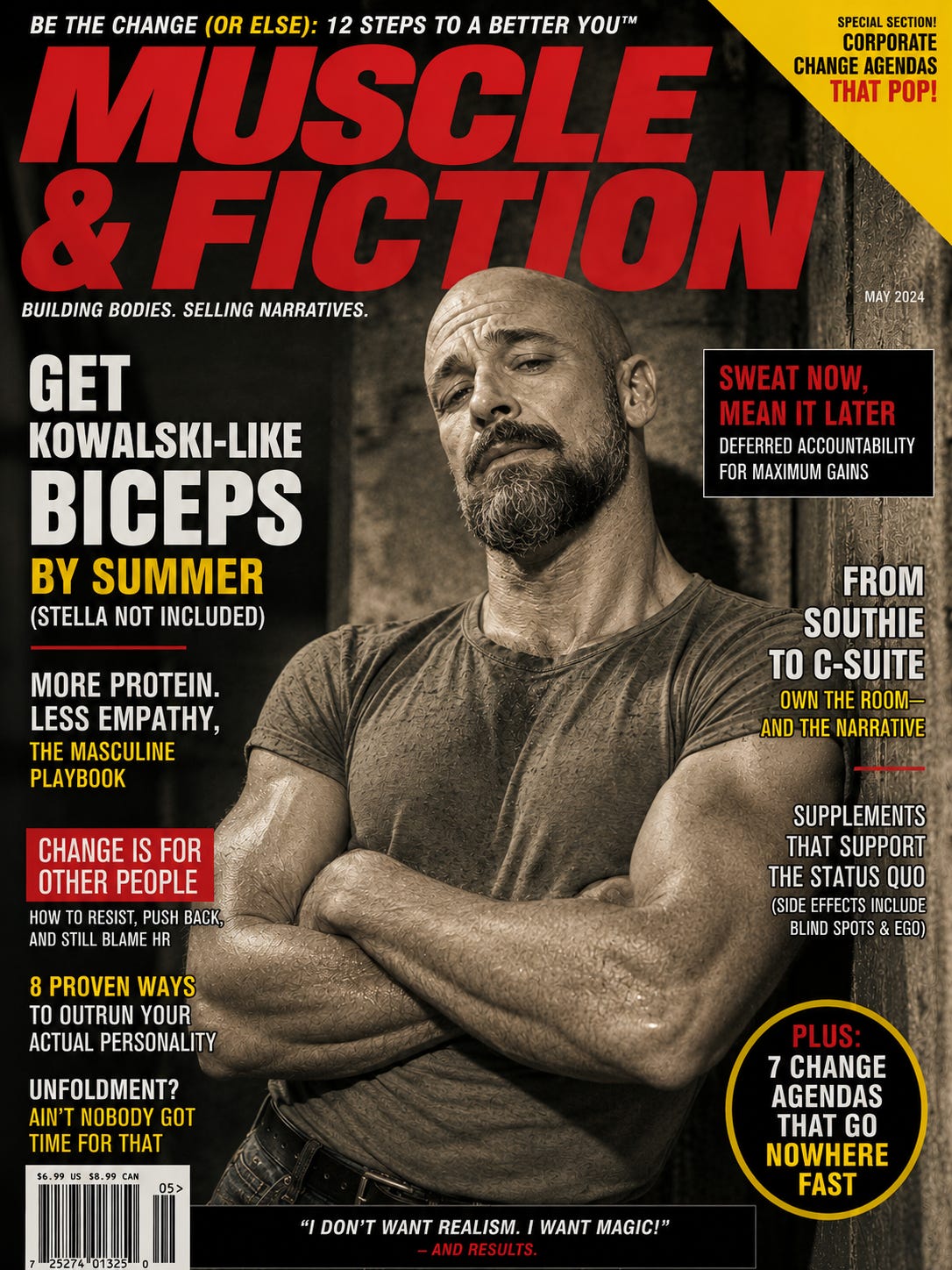
What I eventually figured out was that working out not only kept my body fit, but it also kept my mind fit.
Playing Stanley Kowalski was never my dream. It was Larry’s. Most of us called him “Nutter,” which was (and still is) his last name. Yes. Really.
Nutter had wanted to play Tennessee Williams’s famous character since it was suggested to him by a former professor, long before my time at Viterbo College. Yes, that was the name of the college I attended. Really.
The problem was that I was still built very much like a teenager at the time. That didn’t stop Larry from offering help.
“I’ll give you a program that’ll put fifteen pounds on you over the summer,” he said as if it were just that easy.
“Thanks,” I replied, thinking it all sounded intimidating.
Lifting weights wasn’t my thing. Sure, I’d done a little in gym class. I’d even once had a bench press and some dumbbells, acquired one Christmas. I maybe used them once, but I figured I could DIY a Kowalski bod.
So I worked out in the gym at my Mom’s condo building all summer.
But I didn’t get the part. To be honest, none of us theater dweebs stood a chance against Nutter. It was his destiny to play Stanley Kowalski.
The following summer, I stayed in La Crosse, the Wisconsin town where Viterbo was located. I spent days lifting at the school’s gym, cashing in on Nutter’s offer. I finally put on fifteen pounds that summer.
What I eventually figured out was that working out not only kept my body fit, but it also kept my mind fit. Eight years and one surrendered acting career later, I took a job as a personal trainer at the brand-new 24 Hour Fitness in Hollywood.
Change became my brand, facilitated through self-improvement. I was Captain Change Agenda, full of ideas for making anyone better.
Until I wasn’t
One can recognize the impermanence of everything, but that won’t fix a broken radiator…
It wasn’t until age 49 and a half that I fully woke up to the limitations of self-improvement. Something bizarre happened, seemingly out of nowhere, causing me flu-like pain in my shoulders and arms.
Over the course of several weeks, I lost massive amounts of sleep, muscle, and upper-body functionality trying to figure out what was going on.
I wrote about it in this essay, but the short version is that I started with a dengue diagnosis, then pneumonia, and finally discovered that I’d suffered a cervical disc collapse.
By the time the neurologist put a chunk of metal in my neck to fix it, I was a fraction of my former self. What this taught me is the exact limitations of change agendas: One can recognize the impermanence of everything, but that won’t fix a broken radiator… or spinal disc.
In fairness to former me, I’d already learned a little bit from Buddhist philosophy about how change is always happening, and that all of our best intentions to control those changes only result in more suffering for us.
But let’s not castigate self-improvement entirely.
This isn’t just charity
If self-improvement is about adding something to oneself from out there…unfoldment helps one recognize the depths of one’s own resourcefulness as it exists right here and now.
Self-improvement creates a world with more people invested in their well-being, both physically and mentally. I submit myself as evidence to the jury.
The concern I have with self-improvement is that it starts from the position that I am broken and need to be made more whole. When our efforts to self-improve fail, we try to hone our efforts or double down, often spinning the flywheel of failure even harder.
There’s also a price to be paid for white-knuckling the steering wheel of every outcome in life, which is probably another essay, but worth pointing to.
More to the point, none of us wants to be the victim, like… I dunno, say… be the sort of person who surrenders to atrophy caused by a collapsed disc.
Fuck no. Fight, fight, fight… but in the space between the fighting, there’s something else one can do.
I’ve come to know it as unfoldment. Think seed versus automobile. A seed carries all the necessary parts to create a tree, provided the right environment. A car will only ever change through modifications.
If self-improvement is about adding something to oneself from out there somewhere, like modifications, unfoldment helps one recognize the depths of one's own resourcefulness as it exists right here and now.
Both have their place, but one gets a little more attention than the other. Oh, let’s be honest, nobody is talking about unfoldment.
We live in a world, especially online, that’s dominated by change agendas sold through how-to blogs and social media posts filled with top ten lists of tactics geared toward self-improvement.
Trying to execute them all is more exhausting than reading that last sentence.
Exhausted is the right word
What if I really have been whole all along, and don’t need to be fixed?
Men that I work with in my coaching practice identify that this exhaustion is palpable, but they can’t imagine any way out of it apart from completely giving up. They feel caught between this and trying to improve their self-improvement plan.
The answer, I suspect, is not out there. It’s right here, but seeing it is a little like getting caught up in an intense show playing on a big screen. Sometimes, during a darker scene, you catch your own reflection and realize you’ve been caught up in a story.
Figuring out that we’re more resourced than we know, unfortunately, is a little more complex than this, though. In my own life, it has meant working with the parts of me that show up in response to dysregulated states.
If you don’t know what I mean by “dysregulated states,” read my last essay on the Tyrant I live with, which is short and amusing.
For me, it has meant not fighting those parts, not getting lost in the stories I tend to tell myself. It’s also meant getting to know what those parts of me are trying to make happen, and then recognizing them for that hard work.
That is when something different starts to unfold.
For me, this has been scary but fascinating work. It’s illuminating many of the flies hidden inside my self-improvement paradigms, raising questions in the process.
What if I really have been whole all along, and don’t need to be fixed?
Thanks for being here.
~Damon
Seed nor automobile ✅
How easy it is to fall into the idea that improvement is linear and it would take another lifetime of Buddhist upbringing to undo the previous lifetime being taught that change is not inevitable.
BTW the magazine cover: I want magic not realism 🤣 did you write all the captions?
Nice. It's not an easy feat to articulate self-improvement versus self-unfoldment. I think one of the symptoms of acute self-improvement, where we constantly feel "not enough" in some way, is that we're often driven by inner voices of self-criticism to become a version of ourselves that we believe will be capable of receiving the love and belonging from others we hope to have.
Self-unfoldment comes from learning how to offer that very love, care, and belonging to ourselves through self-connection. Once we know that we can be sources of those needs being met ourselves, we can start to question all of the externally driven activity and experience new options to take action in the world.
Not action driven by less-loss-never. Action sourced from love.
Thanks for the words to play off, brother. Well done.