



When I agreed to watch David Letterman’s interview with Will Smith, I was in no fighting mood. Mother wanted to watch it, and to be fair, I did once think highly of Smith.
The interview aired last year, but had been recorded before the famous Oscars slap. As the conversation unfolded, I was reminded of Smith’s charm. It’s no surprise that so many people used to want him around.
There was one part of the interview that really made me sit up, though. It was toward the end, where he described a particularly difficult Ayahuasca trip, one of 14 such “journeys” he took over the course of two years.
For those who don’t know, Ayahuasca is a Peruvian hallucinogen that lasts about eight hours, give or take, and is usually taken in the presence of a guide.
In Smith’s story, he’s hearing scary voices, losing everything that matters to him, and trying to get to his daughter, who’s crying out for him. It’s all a hallucination.
He shared what it was like for him:
"… I’m totally calm, even though there’s hell going on in my mind. When I came out of it, I realized that anything that happens in my life, I can handle it.”
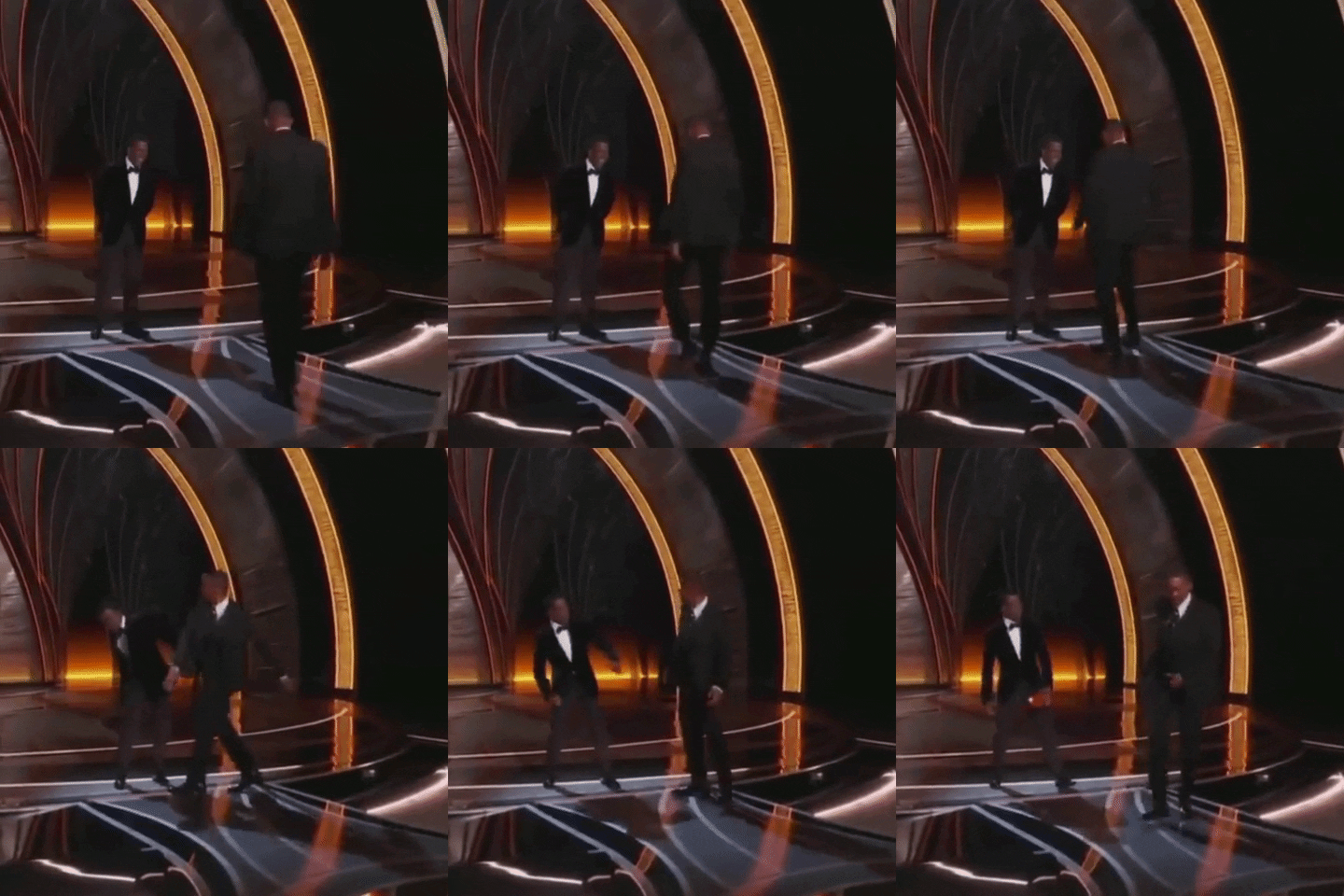
The topic of The Slap Heard Round the World is very dated as of this writing. Sorry about that. You know what, though? It still stings. He broke my fucking heart that night.
What struck me during the Letterman interview was how much he believed that bullshit he spat out about what he could handle. It’s not a stretch to argue that Smith elevated himself to a godlike knowing, and damn it sounded good for a second. It was a good story.
We all do this. We tell ourselves stories about who we are, who others are, and what is happening all the time. It’s beautiful. It can also be a damn problem.
Stories are everything
Stories connect us to the world around us, the people, and the events.
Nobody has to tell this writer. Stories are great.
This is what the brain does with the raw information received. It creates an opus of narratives to understand the world. Most are less like books and more like simple associations.
Stories connect us to the world around us, the people, and the events. Some would argue that stories are the exclusive content of our experience, that there really is nothing else. That’s a fun thought to explore.
Also, stories can carry a risk.
As I developed my meditation practice, I started to believe I would one day graduate from anger. In case you’re wondering, I do still get angry, and unskillfully so at times.
This story did little to hurt me or anyone else, perhaps because… luck. I’ve not yet had to test my anger management as it relates to another person. Mostly, I’ve just learned that I’m still human after all. Thankfully, I’ve been less likely to throw something in recent years.
This makes me wonder, though. What’s the risk of the story I’m telling myself? What exactly makes a story more risky than another? And where is the damn baby in this bathwater?
Superhuman stories
At one point, I’d managed a team of 75 personal trainers. I could sell. I could operate. I could pour a badass drink... How hard could it be?
When Cristina (wifeperson) and I left the US in 2012, it was because of one simple philosophy: We didn’t want to spend our lives working to the bone, hoping we’d one day earn our freedom through retirement, at an age where we’d be too old to appreciate it.
Speaking of stories, when I considered the stories I told myself about my skills in business, it seemed like gaining a foothold in Costa Rica would be easy. I’d been running a multi-million dollar fitness club for a few years, and knew what I was doing. At one point, I’d managed a team of 75 personal trainers. I could sell. I could operate. I could pour a badass drink.
How hard could it be?
“You can buy a bar on the beach for $10,000 US,” my Costa Rican friend Gustavo had told me one night of drinking. “$20,000 will buy you a really nice one.”
Who was I to argue with a Costa Rican?
The thing is, at that point, he’d not lived there since he was a boy, and the country had changed since then. By the time Cristina and I arrived, the going rate for a beach dive was closer to $300,000 US.
We had about $80,000 liquid so we did a little side business with someone we trusted in an attempt to fluff our capital. Let me skip to the end: He grifted us for the larger portion of our savings.
We were suddenly stuck in Costa Rica with our dog and what was left of our belongings; we didn’t have enough capital to buy even a small bar. We managed to make it, though. We liquidated our retirement funds and scratched together enough to buy a small pizzeria. It was so small that only one or two people could work there.
Cristina ran the business, and I started writing for a local marketing company to make ends meet. For years, money was tight.
Speaking of stories, I’ll never forget the time I bought a new pair of flip-flops. We had so little that extras felt like luxuries, even if they were mostly plastic crap.
In the long run, it would take us a full eight years to fully recover that loss. In truth, in some ways, we are still recovering. As our friends back home buy second and third homes, we’re still renting.
“Gaining a foothold in Costa Rica would be easy.”
“How hard could it be?”
Men on a ledge
… there’s actually more than one view: the one to the horizon, and the one straight down.
There’s nothing superhuman about hiking along a cliff. I know, but I love it. There’s something about skirting the edge of danger, overlooking an unfathomable view fit only for the gods.
This was where I (and Cristina) put our lives when we moved to Costa Rica: a ledge.
It’s the same harrowing space I felt Smith step out onto when he made the claim that he could handle anything. It’s the same way I felt when I realized our business partner could not account for tens of thousands of dollars, money I’d willingly handed him.
Standing on a cliff’s edge, there’s actually more than one view: the one to the horizon, and the one straight down.
Looking back, I wish I’d been more invested in the view down. I only imagined the best outcomes, a cheap bar, and an endless supply of booze and blow. I never considered what actually losing our footing could be like.
It makes me wonder how Smith considers that night at the Oscars. How does he think about the story he told himself about what he could handle, or if he even does think about it?
When we sold all the things we owned, including the condo and the cars, I believed beyond a shred of a doubt that we would own Costa Rica in due time. Not literally. Just, we’d do well. It would be easy.
It cost us so much, I find it hard to let it go. I find it hard not to feel regret. If I’m grateful for anything, it’s that it all happened in private, not in front of a televised audience.
Recently, Cristina and I discussed plans for our future.
It was full of so much potential, moves we would make, and rewards we hoped to reap. When I asked her to consider what we would do when it didn’t go our way, for a moment, the only sound was the water dispenser compressor.
It’s lovely to hope for the best. That makes sense, but we’re also too damn old for ledges anymore. Thankfully, Cristina feels the same. Reluctantly, we hammered out a worst-case scenario plan.
There’s one story I don’t regret telling myself, one potential baby in this murky tub.
I’m so grateful that I’m not out here alone, handling things.
Over the years I did a ton of internal work.
Yet I also made a lot of mistakes that would naturally have a person asking if I was really all that aware.
Here's what I came to realize:
You can do a lot of internal work and fool yourself into believing that you've really done the work, when you actually haven't.
I talked a good game, but I didn't live it.
I only started living it when I started in on men's work...and even now I still catch myself in shadow at times. I'm better because there is accountability and also because I'm working with other people instead of doing it all on my own.
The thing about doing internal work is that it really only works when you have accountability to others baked into it.
Hey Damon, that's an interesting story. My reaction is, better to take risks and get disappointed then to never have tried. I can think back to risks I've taken that didn't work out, but I would not have gone back and done things differently because I would've lost the chance to learn. Good luck with your coaching practice, I am sure your clients benefit from your experience