


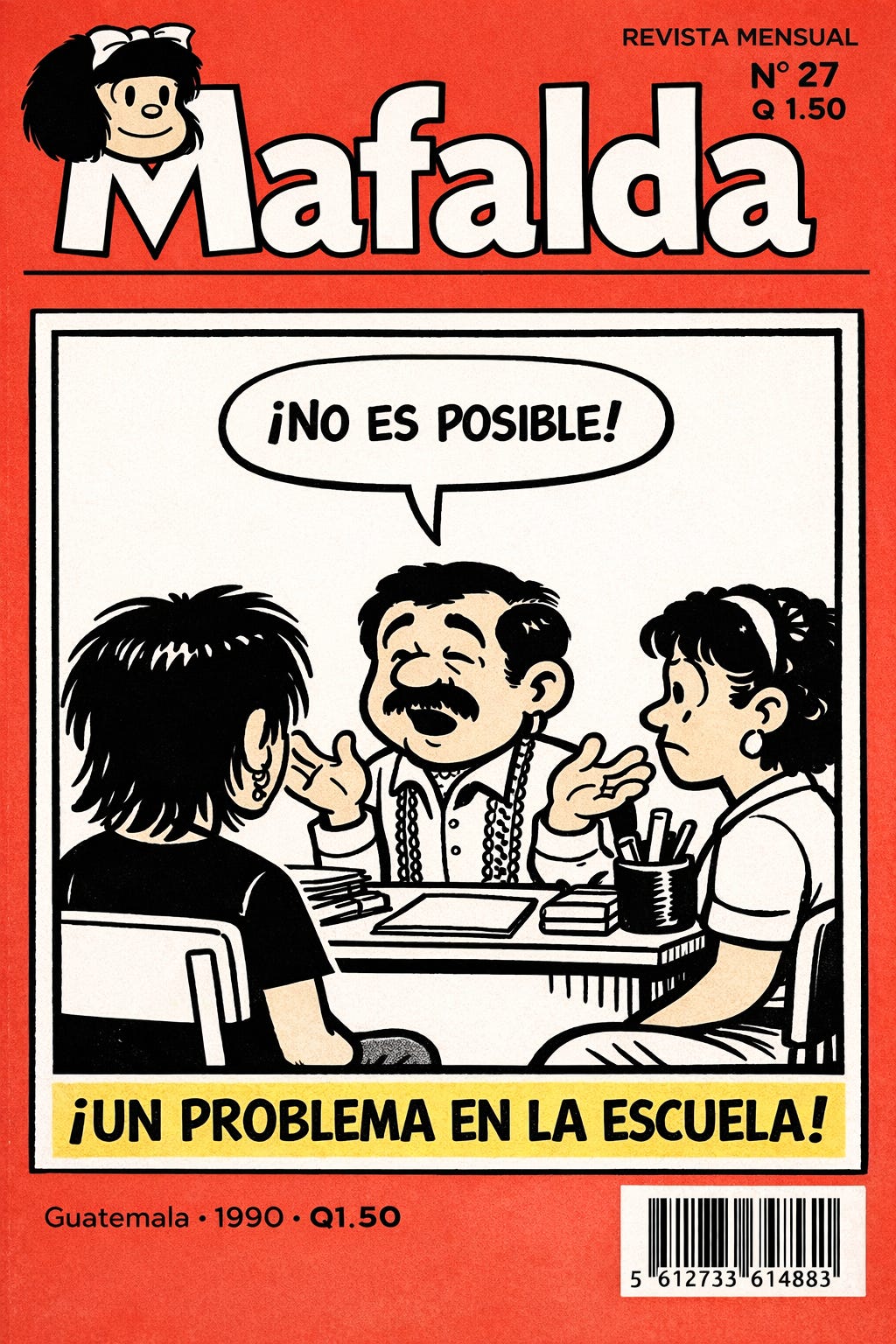
When the school administrator said I would need to cut my long hair and remove my earring if I were to enroll, I knew this would be a very different trip to Guatemala.
This was my third and final trip there as a kid. Decades later, my wife and I would travel there for leisure, but this was about cultural exchange. You know how it goes: Spoiled American kid travels abroad to get his way and not adapt to the local culture.
On the two prior trips, ages 11 and 12, I spent the summer learning how to properly read Spanish aloud, as if I understood what I was reading. That, and I picked up a handful of swear words.
It’s shameful, really. I learned so little Spanish on any of those trips, but I learned something about my resilience.
The whole project would have been a wasted opportunity, but for the fact that I traveled there alone. I didn’t travel with adult delegates or a group of exchange students. I was there because my mother shoved me on a plane to stay with family friends down there.
There was something happening below the surface of all of this that I couldn’t see, something that was both already present and not realized that might have helped me in ways I couldn’t understand at the time. It had to do with initiation, a popular term in men’s work, something that wasn’t even on the radar for me at that age.
Sure, I was old enough to travel alone, but I lacked most of the spiritual deepening and insight that came later.
What was missing was a relationship with any depth of presence.
Boy’s Initiations
Nobody says, “Hey, I know you were a little scared to fly alone to another country, but you did, and you did it well. You’re not yet an adult, but that’s adult-level work right there.”
By age 11, I’d traveled internationally. This was an initiation of sorts, meaning it was a step into adulthood, to being a man.
There’s a compelling essay on non-traditional initiations experienced by real men by Stephen Bradford Long titled The Unacknowledged Initiations of Men. It has powerfully influenced my thinking on initiation and this essay.
What Stephen points to (there and in other essays, like this one) is how boys and men experience non-traditional forms of initiation that are just as valuable, if not more.
For context, there’s a subcultural movement lobbying for the value of initiations into manhood, even for grown-ass men. The Mankind Project is one such organization advocating for this, but there are many voices.
What’s often missing, as Bradford points out, is acknowledgment. There’s nobody who says, “I see you,” as in ”I acknowledge the hard thing you did.” I tend to agree with him on this point.
This non-acknowledgment has consequences, which are beyond the scope of this essay to outline, but suffice it to say it’s more than a lost opportunity. It sends a negative message that what one did doesn’t really matter.
Nobody says, “Hey, I know you were a little scared to fly alone to another country, but you did, and you did it well. You’re not yet an adult, but that’s adult-level work right there.”
As I’m now 51 years old, I don’t know what it’s like for such kids in this modern world. Maybe they do get this kind of acknowledgement, and maybe it lands. I suspect there’s more to this, though. There’s something else necessary.
In any case, many boys grow into men who feel like something is missing, men who find themselves searching. Despite having traveled abroad and alone, I’ve been this man in the past.
Man’s Initiations
Any man who finds a deeper connection to his innate wholeness through any endeavor has my blessing.
These missed connections aren’t the only reason, but I believe they’re part of the reason some adult men just need to go camping with other men, share in that experience, and be witnessed for the effort.
No shade. I support these men getting what they need. There’s just something achy-back-shaped that’s always bothered me about tents, but especially the idea that there’s something necessary about campfires.
This fifty-one-year-old will not be sleeping on rocks or tree roots or even in a glammed-out tent on a deluxe cot to prove his worth. As my mother says, “A Motel 6 is my idea of roughing it these days.”
As such, it’s demonstrative of my cognitive bias that I’ve always smelled something religious about the stories shared by men who come away from male initiation retreats all fired up about what they’ve discovered.
In fact, until I read Bradford’s essays, I’d mostly hand-waved the whole notion. I mean, I was a goddamn Boy Scout. I’ve done my time in a tent. I’ve used a hatchet. I’ve burned shit.
For the most part, I’d considered the case closed until I stumbled upon a text in the support materials of the coach training I’m undertaking with the Aletheia School of Coaching.
… you will sometimes come across an experience that requires strength, courage, and bravery to fully face. When you first encounter such an experience you might default to feeling and thinking that you don’t have what it takes to face it. However, moments like this are initiations. When you face such situations and work through them, you demonstrate to yourself that indeed you do have what it takes.
Since then, I haven’t been able to stop coming back to this idea. It seems to be haunting me, even as it frees me from campfires and tents.
There’s nothing wrong with the culture of organizations like The Mankind Project. Any man who finds a deeper connection to his innate wholeness through any endeavor has my blessing.
But there may be something right here, already present, that simply deserves to be witnessed by another. It’s a part of us that’s toiling in the background, unrecognized for what it’s trying to do, unappreciated, and unloved.
If you don’t have the bandwidth or desire to read the Bradford essay I linked to above, just know that it’s full of accounts by men who’ve already grappled with experiences that required strength, courage, and bravery.
It’s easy for me to imagine that just airing those tales was enough for the men in them to feel seen for their bravery, and maybe that’s true, but as one commenter to the essay points out, it’s about more than being seen.
It feels like there is something else being smuggled into these formalized initiations, unnoticed, something of value that isn’t so obvious.
Presence
None of our initiations are as valuable in the absence of an awake and aware presence. It’s not enough to simply be there.
This is the missing ingredient in all our unrealized initiations.
It’s this complex concept, one that spans from what’s obvious to something less obvious. We tend to just call it presence. It’s a word that does a ton of heavy lifting, though, quietly in the background.
When it comes to initiation, depth of presence is the distinguishing feature, or what I would call our relational depth of presence.
There are generally three ways we think about it, but one more often than the rest. Most of the time, we’re just talking about being there, showing up. Bob was present.
That’s one end of the spectrum.
In the middle, we might speak about someone’s quality of presence, as in “Bob demonstrates a higher level of presence with a more qualified audience.” This is the larger gradient of the spectrum. It’s subjective to the person and situation, but we have an intuition about it.
We can even tell when we’re deeper in this form of presence, even if we can’t rate that depth. We can also intuit when others are deeper at times, as in “Bob seemed more present today than normal,” or “I was very deep in a state of presence during that event.”
This broad, and deeper than showing up quality of presence is what we crave. For men, at least, there’s something about a man who compels the attention of others simply by his depth of presence. It’s something we imagine all good leaders possess.
One can follow this scale all the way down from the first version mentioned to something that starts to sound spooky. That’s where we find the least often way we talk about it.
The best word I’ve found for it is field. There appears to be an ambient field of presence, like an electric or magnetic field. Anyone who has taken psychedelics will be familiar with this, but someone can notice this field without the use of mind-altering substances.
But. We needn’t grapple with esoteric and darker corners of presence to get what we want from it.
We can stick to the more pedestrian end, something just a smidge deeper than just being there. That’s a fine place to stay until we feel compelled to understand more, which may never come.
But this much I’m starting to believe is true about presence and initiation for men.
None of our initiations are as valuable in the absence of an awake and aware presence. It’s not enough to simply be there.
This is what I believe the critical commenter from Bradford’s essay was pointing to, albeit not directly.
Presence is never lost
Doing so feels like getting a loyalty card stamped weeks after purchase because you forgot to bring your card at the time. It still counts.
We never lose it. It’s always available. And as long as we can remember them, we don’t lose our initiations either.
When, after my father moved out, I fixed the faucet or a broken electrical socket, it felt empowering. It also felt different to tell my best friend, but I wouldn’t argue that either of us knew a damn thing about this field of presence.
This moment didn’t feel like an initiation at the time.
Similarly, coming home from Guatemala and sharing with my friends about the trip, I felt some… thing shift, but it didn’t register as an initiation.
But from where I sit today, revisiting these inflexion points, I can do so from a deeper state of presence.
Doing so feels like getting a loyalty card stamped weeks after purchase because you forgot to bring your card at the time. It still counts. I think this is what Bradford was pointing to.
The process of witnessing my former self from my current depth of presence retroactively elevates these experiences to the level of realized initiations.
What I now understand from Aletheia is that this work is more powerfully experienced with another person, pointing us right back to the thesis of Bradford’s piece.
In such cases, nothing has been lost. Not permanently.
Thanks for being here.
~Damon
What came up for me when reading this was the idea of proper adult development. We find ourselves on threshold moments throughout life that challenge, stretch, and often break us. They give us opportunities to discover more of who we are and what we are capable of leveraging to meet those moments. This gives us both a renewed sense of ourselves and a sense of our own value to our social groups.
In the "good old days" (or really, just the old days), these thresholds were proper initiations given within the context of a very predictable rhythm of communal life. You could predict them, because life looked pretty standard for everyone across very long time horizons. You knew what these individuals needed to become in order to support the tribe. So, you had initiations to help them become more and more adult - less dependent, more independent, and eventually more interdependent as elders.
Now, in our much more chaotic and fluid modern times, we have the same developmental needs as adults, but far less predictability and structure for a common life. We don't have initiations anymore. We do have thresholds.
In all cases, Presence is the catalyst for this development. To your point, we need to be WITNESSED in these threshold moments in order for them to take hold - they are not a solo sport. However, we lack initiation rituals for common life, so there's a need for a more organic way of meeting people in those thresholds so the developmental leap can take hold.
This, I believe, is the role modern coaches are being called to fill - among others.
Hey Damon!
Great article, but I wonder here if you and Stephen are using the word "initiation" in a way that is different to the inherent anthropological interpretation in which the term is usually spoken of.
It seems like you and Stephen are arguing that initiation happens organically and often painfully in Stephens example, through the circumstances of everyday life, which is a different sociological mechanism and different definition from which I understand and write about the term.
I feel like Stephen's essay, and your focus on presence, although valid, its the top layer of a deeper problem, by almost romantizing trauma as initiation, and this is because we have lost lots of the older "proper" initiation frameworks seen throughout the anthropological record.
Without structured, communal rites of passage (whatever we may call these in the modern day) men end up abandoned to suffer in isolation and forced to retroactively invent meaning for their pain just to cope, or hope they have people in their life to acknowledge these moments or curate enough presence to recognize them himself.
Your point is correct that presence is key to being able to recognize these things as important and thus able to leverage them properly. But by calling these life events initiations I fear we're basically slapping a noble label on societal neglect and the loss of actual guidance.