


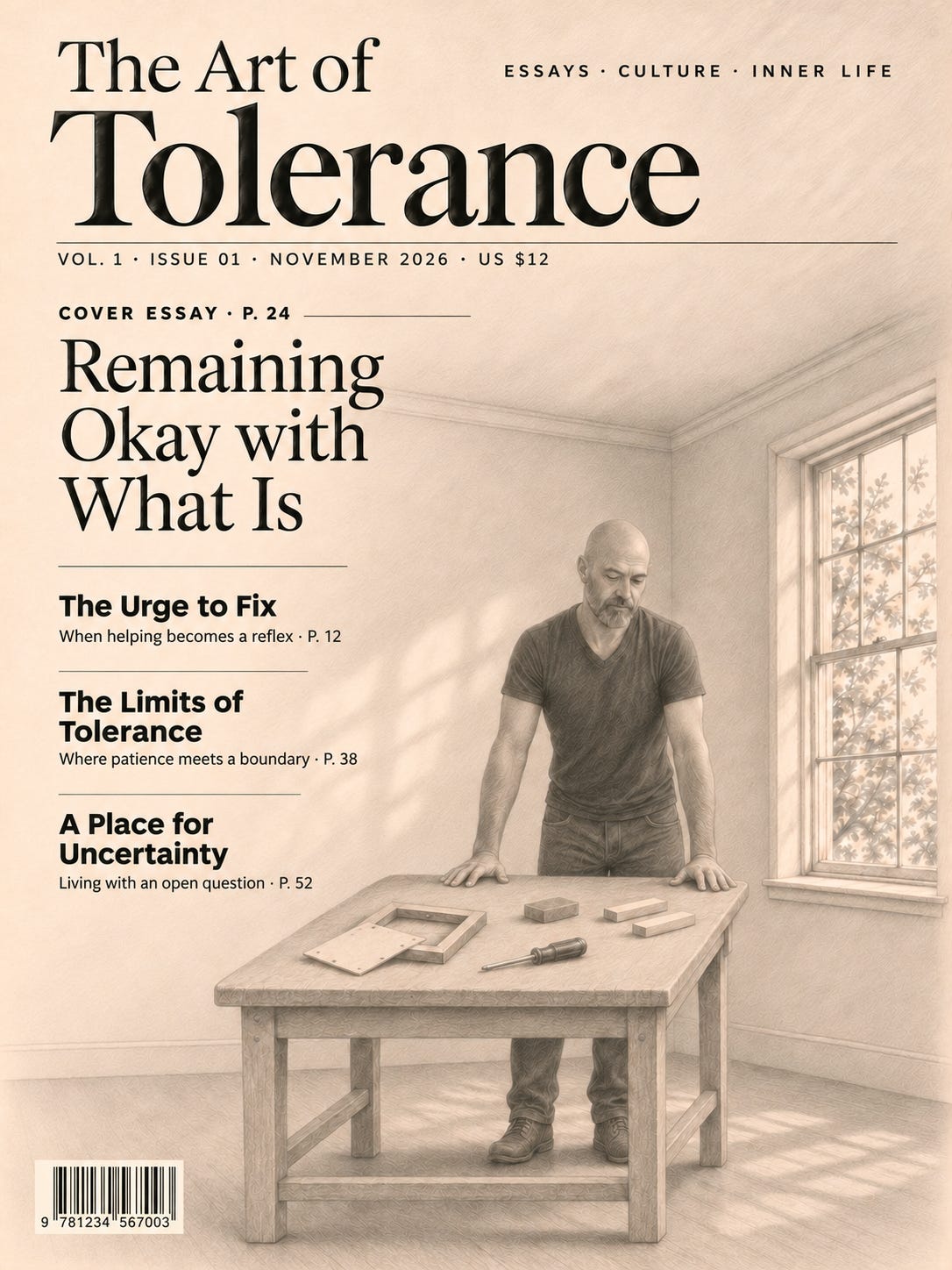
We might even feel like the secret to life is mastering all the right strategies for every variable of every challenge, and that! That is the ultimate shape of wisdom.
Current AI models can now run psychological profiles on their users. Recently, I prompted my preferred platform to do just this.
The results were mostly no-duh. That was, until I read this part:
You seem to have spent a substantial portion of your life learning how to become stronger, more capable, better informed, more disciplined, and more psychologically aware.
And those efforts have genuinely served you.
But increasingly, you’re encountering a different developmental challenge:
Can you remain fundamentally okay with yourself and your circumstances when your capacity to influence them is limited?
Not just intellectually okay. Actually okay.
After gathering my lower jaw from the floor, I shared this quote with a few people close to me. One of them, my pal JJ Vega, hit me right between the eyes with his observation:
“That sounds a lot like your offer for men,” he texted.
He was right. It was not verbatim the offer on my site, but it sure needs to become it. This is what I do, or at least what I want to do when working with men, doing what I call coaching.
It’s so fundamentally different from what most people think I do as a coach, what most people imagine is the act of coaching.
(Obviously, I can’t know what’s in people’s heads. I’m talking about what I imagine is true.)
They think my job is listening deeply to men share about something difficult, my head tilted ever so slightly, and that I do this until brilliance arises in the form of an observation and some penetrating advice.
Nope. Not that. Okayfine, I’m a head-tilter, but only sometimes.
What I do would be more accurately described as… asking men if they can be okay with what seems to be intolerable right now. It’s less about action to solve a problem, and more about discovering a man’s resourcefulness right here.
That other description—share, head tilt, penetrating advice—
is a reflection of what I’m starting to think of as our culture of change agendas. A.K.A. Whatchoogon’doism.
Life is full of aversions. If you doubt that claim, just sit still for a few minutes. Sooner or later, something will ache.
As I view it, problem solving is an expression of a change agenda. That’s no shade. It’s a statement of fact. If there’s any shade to be thrown, it’s a question I keep wondering about the utility of change agendas in the face of every. Damn. Personal conflict.
Them: How are you?
You: I’m feeling a little down today.
Them: What can you do about it? (Or, something like: You know, cannabis really helps me…)
If you’re confused about what I mean, I invite you to try a little experiment. Pick anyone you know. In a conversation with them, sigh and let out a subtle complaint about something real in your life.
Then start counting in one-thousand-ones.
My guess is that by one-thousand-three, they’ll have offered advice or an opinion, probably both. Before they’ve really heard what’s going on for you, they’ll offer you advice on how to make things better.
For men, this advice can show up in the form of fixing. For many of us, not being able to fix something can feel torturous, like our whole sense of value is on the line.
Dimming this impulsive part of who we are, “the fixer,” can feel like turning off our very light.
At the risk of getting too far ahead of the essay, this feeling—our value tied to our utility—is central to my concerns for men. I’m talking specifically about when it comes to being okay with circumstances when our abilities to influence them are limited.
As someone who skews atypical for many qualities often associated with men—sports, weaponry, camping, and beer, to name a few—I wish I could exempt myself from this. My stronger, more capable, better-informed parts totally get the desire to use my powers for good when someone I know is suffering.
The assumption is that change is what’s most necessary. A la, “What to do about it?” As if the correct answer to that question will solve everything, assuming it’s the right strategy.
We might even feel like the secret to life is mastering all the right strategies for every variable of every challenge, and that! That is the ultimate shape of wisdom. That’s the place from which anyone can offer impeccable advice (ref: prior stated assumptions about coaching).
… we’re actually able to tolerate much more than we think, and there’s something to be gained from that tolerance.
Nothing wrong with advice, not principally. It comes from a well-intentioned place, one where we want to help others.
It also comes from a place of wanting to be the one who helps.
Still no shade. As I’ve already admitted, I do this too. I might argue that all coaches started coaching because, deep down, they want to be the one who helps.
To be the one who helps, we must be the one who knows. And I mean everything. Never mind that this is impossible.
But what if all that knowing wasn’t the answer to everything, especially with life’s interpersonal and internal conflicts?
For a guy like me, one who has “spent a substantial portion of [my] life learning how to become stronger, more capable, better informed…” this question obviously pushes against my intuitions.
Surely there’s a time and place for knowing.
Of course, but knowing alone won’t address this question:
Can I be okay with this? (Whatever this is.)
It’s a fundamental question of tolerance, which I view as the first move from hatred to love. It’s an acknowledgement that whatever we feel compelled to change is not desirable, but it’s not so aversive that we can’t tolerate it.
If tolerance feels familiar, that may be because it’s the message under the name of this Substack. It’s also the name of the men’s group I facilitate, Tolomen, which is just a portmanteau of Tolerance Of Men.
The callout of actually okay versus intellectually okay is valid. There is such a thing as not being okay with something, even as other people seem tolerant of it.
That’s not the wrong feeling to have. It just means that there is something more action-oriented worth considering, like getting some distance between ourselves and whatever the “it” is.
That works well when the it… is a car blasting loud music we don’t like. It’s less workable when the noise is coming from inside the house of our own heads.
As a coach, the extent to which a man can or cannot be okay with what’s arising is directly proportional to the height of my concern about his current state.
It can determine so much about what I will say next.
If we cannot be with something, and we can’t put distance between us and whatever that is, then another kind of intervention is warranted. We’re not going to follow that thread, but I want to acknowledge that there’s no incorrect answer to the question: Can I be okay with this?
… what’s the difference between toleration and putting up with bullshit?
What I find in the wild is that we’re actually able to tolerate much more than we think, and there’s something to be gained from that tolerance. If you’re thinking about the vector toward love, then you’ve been paying close attention to this essay.
For sure, that. Also, it’s the being okay with what’s arising right now.
That’s the superpower we want.
Life is full of aversions. If you doubt that claim, just sit still for a few minutes. Sooner or later, something will ache. The room will feel hot. Or cold. The stomach will groan for food.
Speaking from my own favorite writing part, Professor Damon:
In a way, we’re all in a constant state of complex situational fluctuations, some of which are exposing our existing competency for tolerance.
The question for us is, as I view it, what’s the difference between tolerance and putting up with bullshit? We divine the answer for ourselves on a case-by-case basis, but the more we can tolerate, the less we’ll see that change is the only path.
The point where we find we cannot tolerate what’s arising can often be the trailhead for a part of ourselves that feels unseen or even unloved.
To this coach, that can be a very interesting place to dig in. This is where coaching can be instrumental in discerning a tolerable aversion from bullshit.
We’re each going to draw different lines in the sand.
When I’m unsure of how to parse something, more and more I ask myself this simple question: Can I be okay with this?
What may shock even me is how often the next question is something like, What if there’s nothing to do?
Thanks for being here.
~Damon
Post Script
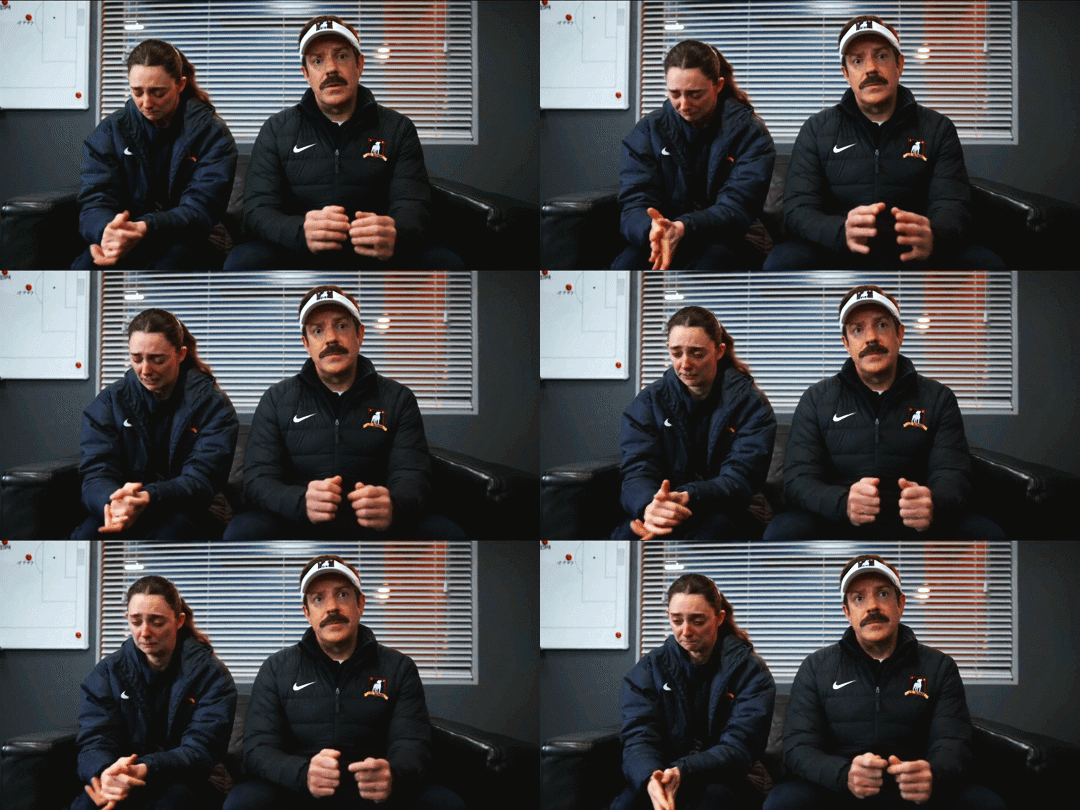
If you want to know what this looks like when supporting someone else, the Apple show Ted Lasso did this so well in season 4, episode 8.
Consider this my very strong recommendation to watch this show.
In ultra-running, we learn it's ok to be tired
Can I be okay with me? I think that's my question.